May Orchid Events
Posted May 1st, 2021 by Marc CohenCategories: Events
Most of the orchid world continues to exist online. Check with your local orchid society for virtual meetings, shows, auctions, expert talks, and more.
Every now and then, I manage to kill an orchid. Recently, it was my Ada aurantiaca. The species has been renamed Brassia aurantiaca, but I bought it under the Ada name, so that’s how I usually refer to it. After it died, I realized that we didn’t take many photos of it over the years. Fortunately, I have enough to illustrate it here, and also a few more from shows and gardens.
This great cool grower really stands out with its brilliant orange flowers. I had repotted it before without problems, but a couple years ago, after repotting, I left it in a damp, shady location for too long. When I finally realized it after a few months, most of the plant was rotting. That’s an uncommon issue for me, especially for my outdoor plants, which live in windy conditions near the ocean. I doused the orchid with hydrogen peroxide, rinsed it off, and coated it with cinnamon powder. Those natural remedies are very effective in stopping fungal and bacterial rots. Later, I moved it back into a sunnier spot. However, the remainder of the plant never thrived again. Two years later, it died during a heat wave.
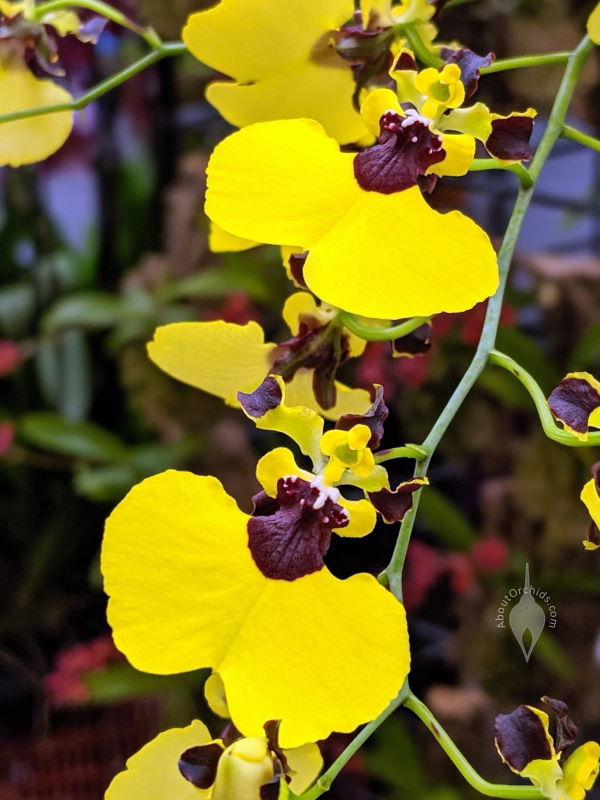
To supplement the first three rows of photos of my plant, in the fourth row, there are two pictures from Dave’s trip to the Cloud Forest Conservatory in Singapore, and one from the 2018 Pacific Orchid Expo. The Singapore photos show yellow varieties. If I ever buy another Ada, orange or yellow, I’ll remember to take more pictures.
The Nepali Times lays out the perils facing orchids in the Himalayan country. Nepal’s mountain valleys are full of cloud forests with rich orchid life. The country is home to over 500 different kinds. (By comparison, the USA and Canada have about 250 native species.) Many varieties are part of traditional medicines, and are legally exported to China or India. Sadly, many more are illegally poached from the wild and smuggled, which takes a terrible toll on native populations. There are two dozen orchid species among these medicinal plants, including a dozen Dendrobiums. Enforcing conservation laws is always difficult, but determining whether a shipment of dried orchid stems are an endangered species or not is almost impossible. It’s just one of the major conservation challenges faced by Nepal and other countries. Conservation groups hope to bring more awareness and more enforcement to help save Nepal’s orchids.
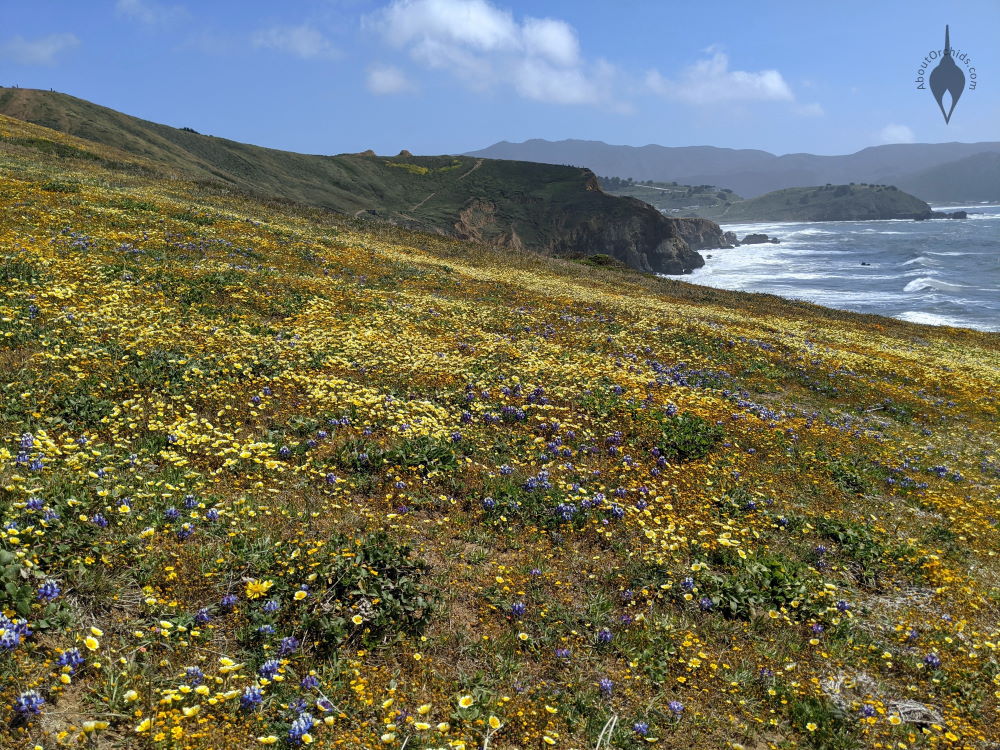
At this time of year, the Northern California coast is full of blue flowers. They’re not orchids, but they’re one of my favorites nonetheless. California Lilacs, or Ceanothus, are a North American genus, with many species native to California. They’re a staple of local gardens, currently blossoming in front yards, on hillsides, next to parking lots, and even growing over chain link fences. California Lilacs come in many different forms, from small shrubs to small trees, miniatures, and groundcovers. There are also different color varieties, with dark blue, lavender, or white flowers. Their clusters of tiny, fragrant blooms are bee favorites. Caterpillars of California Tortoiseshell Butterflies feed on their leaves.
The coastal varieties which do so well here are drought-tolerant, and tough enough to grow among invasive and dominating ice plants, which choke out most everything else. They can handle salt and wind. Most stay green all year, but there are deciduous types, too. Ceanothus are nitrogen-fixing plants. To cultivate California Lilacs, plant in soil with good drainage, and grow in full sun. They should be watered throughout their first year, but kept dry after that. Skip the artificial fertilizers, which they don’t like. Protect from deer where needed. Small leaf varieties may have less appeal to browsing deer. With cool, coastal weather, and very little care, they provide years of brilliant blue blooms.
Among many peculiar pollination strategies in the orchid family, some South African species really stand out. The small blooms of Disa chrysostachya offer nectar to entice Malachite Sunbirds to perch on their flower spikes and take a drink. But instead of attaching to their beaks as they feed, the pollen sticks to their claws. Then they fly to another flower spike, carrying the pollen, and fertilize the orchids with their feet. It’s certainly an unusual adaptation, even for an orchid.
Marianne North was a phenomenal botanical artist of Victorian England, and you can take a virtual trip to enjoy her gallery at RBG Kew in London. Check out the two videos below, and also photos that Dave took during a visit to the UK in 2019.
North’s extraordinary art includes many orchids. She traveled around the world on her own, which was very rare for women at the time, to paint plants, animals, and wild scenery. Her works capture exquisite details, and also convey her love of nature. In the process, she discovered plants unknown to science, and innovated important botanical art techniques.
The Marianne North Gallery is home to over 800 of her pieces at Kew Gardens in London. Its dense arrangement of paintings, with little empty space between them, is reminiscent of the dense layerings of life she was recreating. It’s a lot to take in, whether online or in person, but definitely worth the time.
We’ve suffered through the COVID19 pandemic for over a year, and there are still in-person shows listed online without any mention of basic safety precautions. It’s ridiculous, and I won’t have any part of their irresponsibility. You won’t find those shows in my list. Below are New Zealand and Australian shows which do have precautions, and one really big online event. The World Orchid Conference is also known as the Orchid Olympics. It happens every three years, and was postponed last year. This month, a limited, in-person exhibit with COVID19 precautions will happen in Taiwan, and much of the conference will happen online. It’s pricey at about $100 (USD) registration fee, but it is a great opportunity for everybody around the world who would like to participate in this major orchid event.
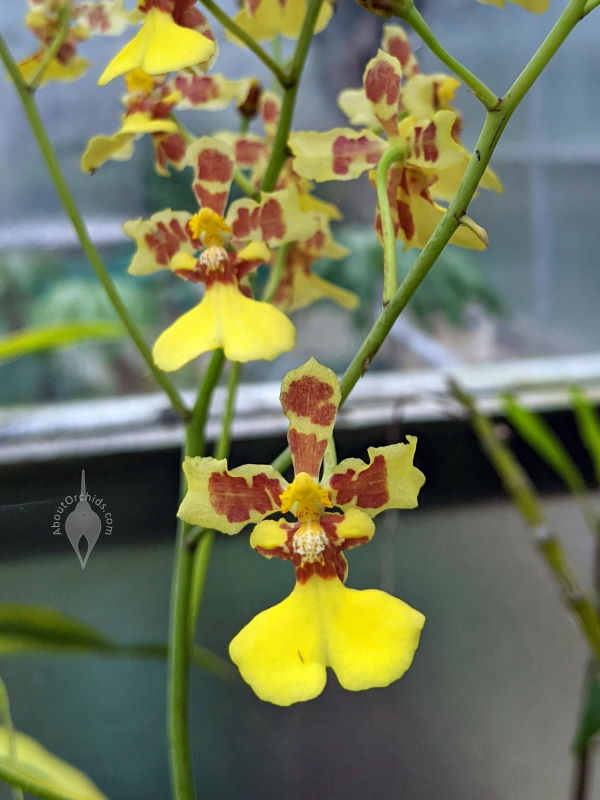
In the UK, Awards of Garden Merit (AGMs) are given to worthy plants, including orchids, by the Royal Horticultural Society (RHS.) AGMs are varieties which are reliable, easy to grow, and commonly sold in the UK. The three photos above represent orchids which currently have AGMs. They are Pleione formosana, Stenoglottis longifolia, and Oncidium Sharry Baby, the chocolate scented orchid.
Unlike other orchid awards, these are not given to individual plants. They are presented to species or hybrids which are found to be tough, dependable bloomers with appropriate care. Dozens of orchids have AGMs, such as Jewel Orchids, Lady Slippers, and Cymbidiums. The RHS list has hardiness info, and which kinds can be used alpine or rock gardens. Outside the UK, these plants may not be available for sale.
Lots of orchids have been blooming in our late winter garden, eager for today’s change of season. My favorite purple Zygo reliably boasts stunning flowers, shown in the first row of photos above. Their beauty is surpassed by their sweet fragrance, which is one of my favorites. The second row features a wonderful Coelogyne, which was a gift from a neighbor’s garden. The crystal white flowers have a rich orange lip. In the last Coelogyne photo, there’s a small spider hiding in the petals.
The last two rows of photos contrast two different Cymbidiums. The first row is a hybrid with Cymbidium tracyanum in its parentage, and the second row is Cymbidium tracyanum itself. It’s easy to see the patterns and colors shared between the two. They’re great sights to greet springtime.
The Smithsonian Environmental Research Center explains the life lessons offered by North American orchids. If the Queen’s Lady Slipper can take 16 years to bloom, certainly we humans can learn to take our time. When Three Bird Orchids bloom en masse to better attract pollinators, they are exemplifying the importance of teamwork. For all that there is to learn from our native species, it’s important to protect them. Support the fight to save our native plants at the North American Orchid Conservation Center.