Orchid Photo Contest Winners

Posted April 22nd, 2012 by Marc Cohen
Categories: Botanical Gardens, Events, In the News

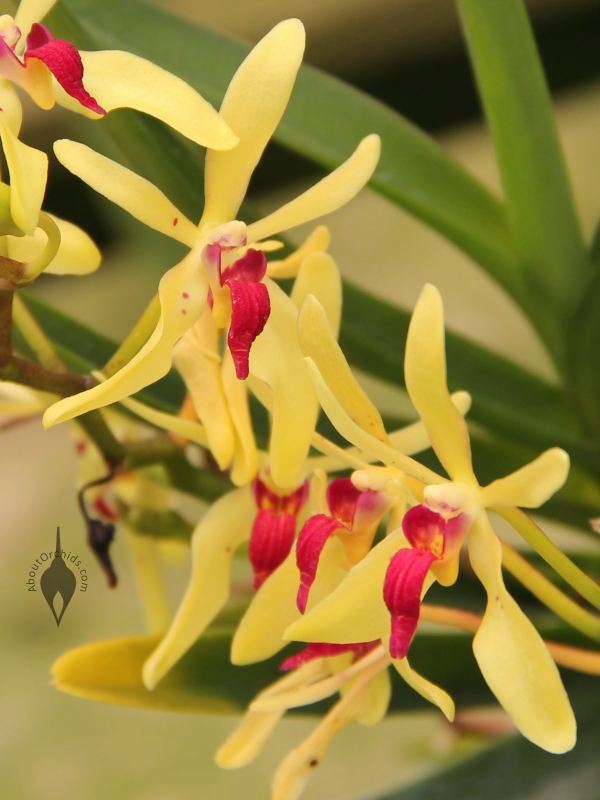
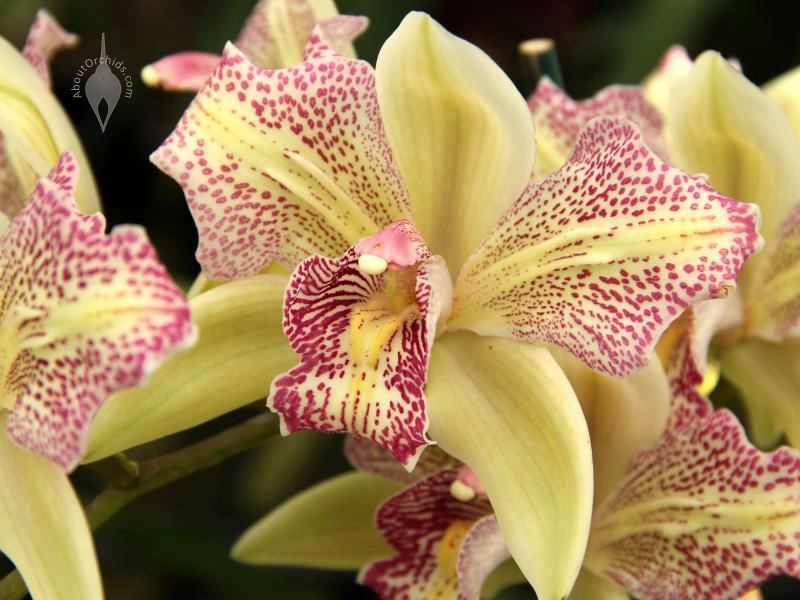
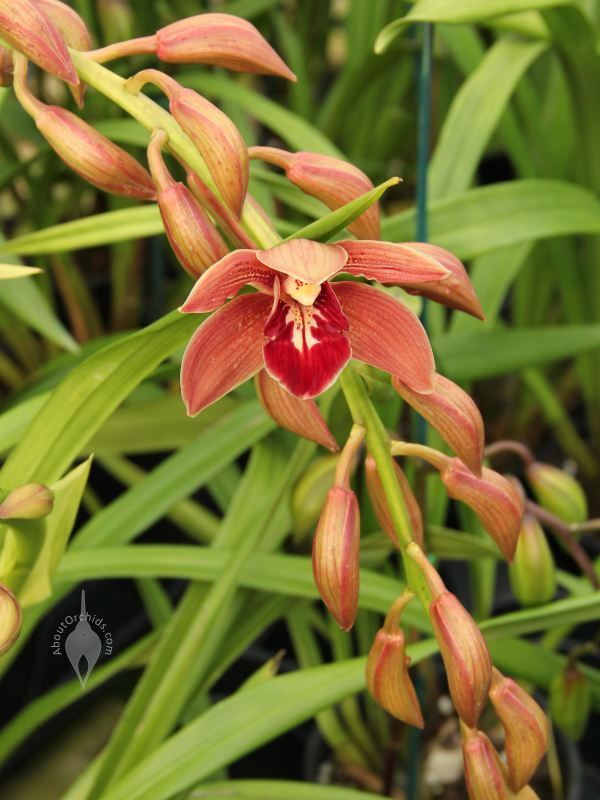
An orchid photo contest at the Cleveland Botanical Garden has picked some real winners. The pictures highlight the sights of the garden’s winter exhibit “Orchid Mania: This Side of Paradise.” The annual contest is co-sponsored by The Cleveland Plain Dealer and Cleveland.com, and this year saw almost 300 entries. Check out the winners’ gallery, or view all of this year’s photos online. Third place winner Carole Jurack observed “Sometimes just getting up close to the flower is all the incentive one needs to see the flower in a unique way within its environment.”

Orchids in Kona

Posted April 20th, 2012 by Marc Cohen
Categories: Growing, Misc, Photos, Warm Growers

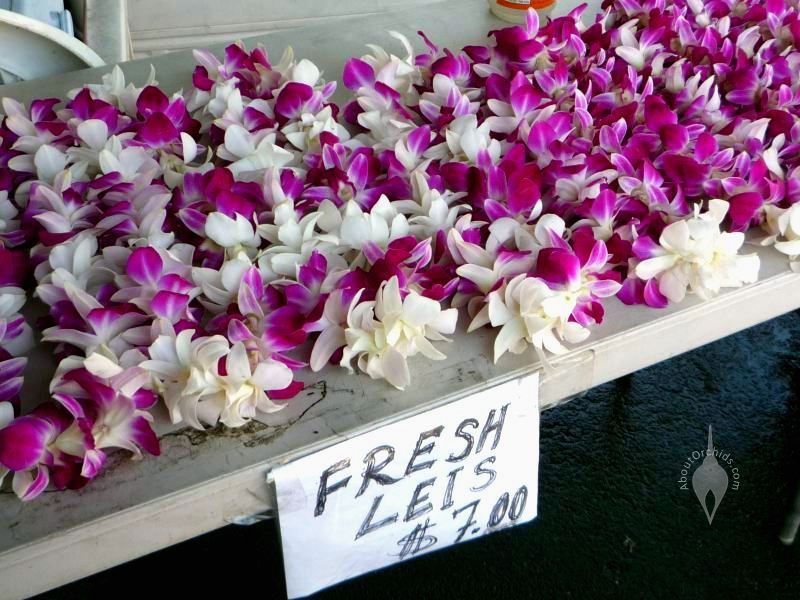
It’s easy to think that a tropical place like Hawaii is full of orchids. That’s certainly true in some parts of the islands, like Hawaii Tropical Botanical Garden near Hilo. However, in other parts of Hawaii, orchids aren’t as common. Kona lies on the other side of the Big Island where rains are rare, and the air is dryer. The name Kona means “leeward” or “dry side” in Hawaiian. Orchids are limited here. During a recent visit, we saw lots of Dendrobium hybrids in pots or made into leis. We also spotted some Phal hybrids for sale at a roadside stand (sitting in full sun, by the way,) but not much more.

Leis made from Dendrobium flowers for sale in KonaPotted Dendrobium orchid near KonaPhals for sale at a fruit stand in South Kona

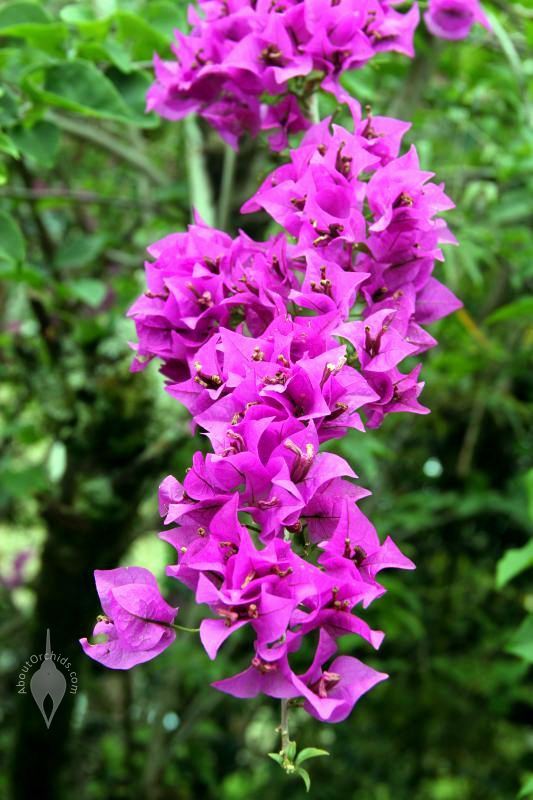
It’s an interesting contrast to the wet side of the island, where orchids grow as weeds and drip from the trees. It’s also a reminder that orchids don’t favor deserts: they need regular moisture and good humidity. In your own home or office, whether the heater is running or the air conditioner has turned on, orchids suffer in the dry air. Many other tropical plants, like Kona’s copious bougainvillea and fragrant plumeria, are drought-tolerant. They don’t mind the dry air, but orchids do. In dry conditions, they start to attract pests, quickly lose flowers, and fail to thrive. Bring orchids to the wet side, not with more frequent waterings, but with added humidity. Meanwhile, Kona has lots more stunning flora and fauna to enjoy.

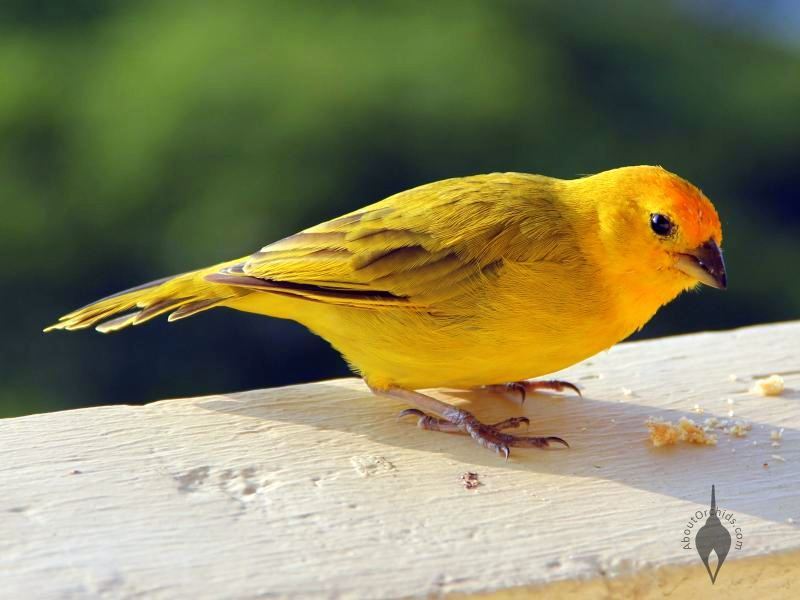
Bougainvillea flowers in KonaFragrant Plumeria flowersSaffron Finch in Kona

Outdoor Orchids in San Francisco

Posted April 16th, 2012 by Marc Cohen
Categories: Cool Growers, Growing, Growing Orchids in San Francisco, Intermediate Growers

Welcome to a new blog category for “Growing Orchids in San Francisco” with info of interest for the Bay Area. Some old posts fit the new category, too, so I’ll go back and re-label those with local relevance.

This post is the first half of a list of orchids I’ve grown outdoors over the years, with a few notes added. They’re all cool or intermediate growers, befitting San Francisco’s mild, foggy climate. Most have survived an occasional hailstorm, and we’ve managed to protect them from our rare winter freezes. For fellow gardeners in Sunset climate zone 17 where microclimates rule, you may find varieties that will work outdoors for you. The second half of this list will follow in a future post.

  • Ada aurantica grows and blooms reliably every spring.
  • Arpophyllum giganteum flowers dependably every fall. A few seed capsules appear each year.
  • Bletilla striata grows and blooms reliably every spring.
  • Chondrorhyncha lendyana flowered well, but died after repotting. I believe it prefers to be mounted.
  • Cochlioda vulcanica grows and blooms faithfully every fall. Flowers often last through the winter into spring.
  • Coelia bella was a new purchase last year, and flowered nicely for the first time last winter.
  • Coelogyne mooreana grows and flowers reliably every summer.
  • Cymbidiums guarantee blooms every winter. One of my hybrids has never failed in 15 years, and another blooms a second time in spring.
  • Cyrtochilum macranthum flowers dependably with dozens of large blossoms at the end of each summer.
  • Dendrobium kingianum and Dendrobium x delicatum grow and bloom reliably every spring, Den. kingianum needs a dry winter, but the Den. x delicatum hybrid can tolerate winter rains and still bloom.
  • Dichaea glauca has grown for years but never flowered. I’ve tried it indoors too, without success. It continues to put out new growth each year, so there’s still hope I’ll figure it out.
  • Dockrillia striolata didn’t bloom for the first 6 years I had it, but now blooms each spring.
  • Domingoa (Nageliella) purpurea has flowered over the past 2 summers.
  • Dracula sodiroi flowers sporadically. It might be more reliable if I used purified water instead of tap water, but I’m not set up for that outdoors.
  • Encyclia vespa grew and bloomed well for many years. It required full sun.
  • Epidendrums flower continuously for years. Keikis of cool-growing varieties turn into large plants within 3 years. The most vigorous type, which may be Epidendrum x obrienianum, is pollinated by local Anna’s Hummingbirds. Seed capsules often form, and seed is viable. Seedlings pop up in nearby bonsai pots, and can grow to flower in 3 years.
  • Epipactis gigantea, a San Francisco native, grows and flowers vigorously each summer. Seed capsules occasionally form. It lives in a tray of water all year, even during winter dormancy.
  • Helcia sanguinolenta blooms every other year in winter.
  • Holcoglossum kimballianum has grown outdoors for 2 years, but not flowered yet. It lives indoors over winter.
  • Laelia anceps thrives and blooms 2 or 3 times each year.
  • Lemboglossum majale has only flowered once over the years. It may prefer warmer nighttime temps than we have.

Santa Barbara Orchid Estate

Posted April 12th, 2012 by Marc Cohen
Categories: Buying Tips, Misc, Photos

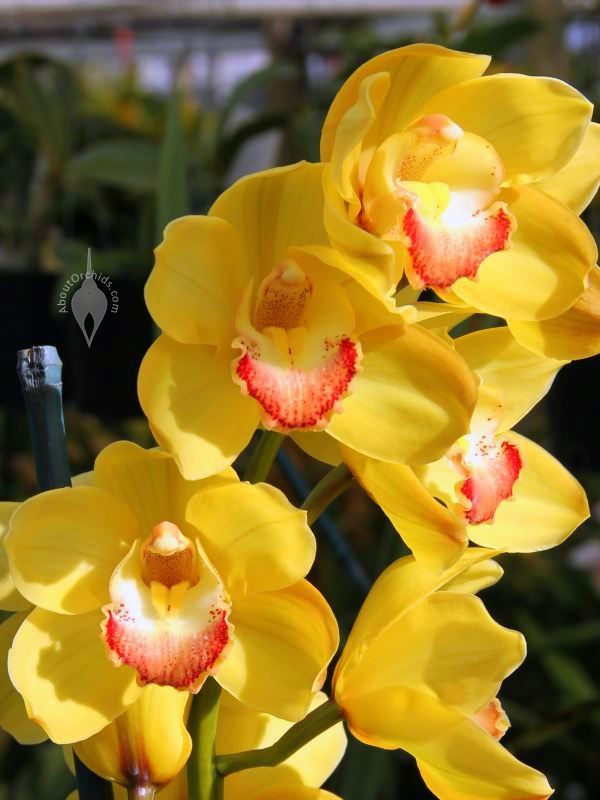
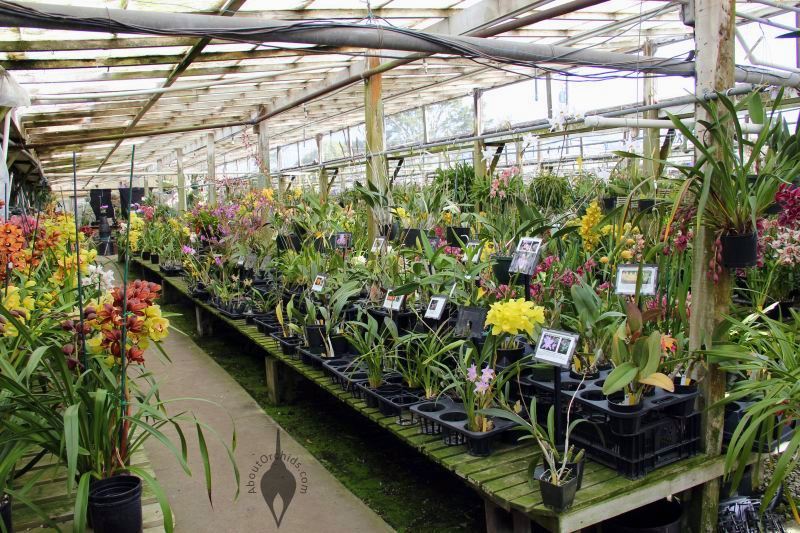
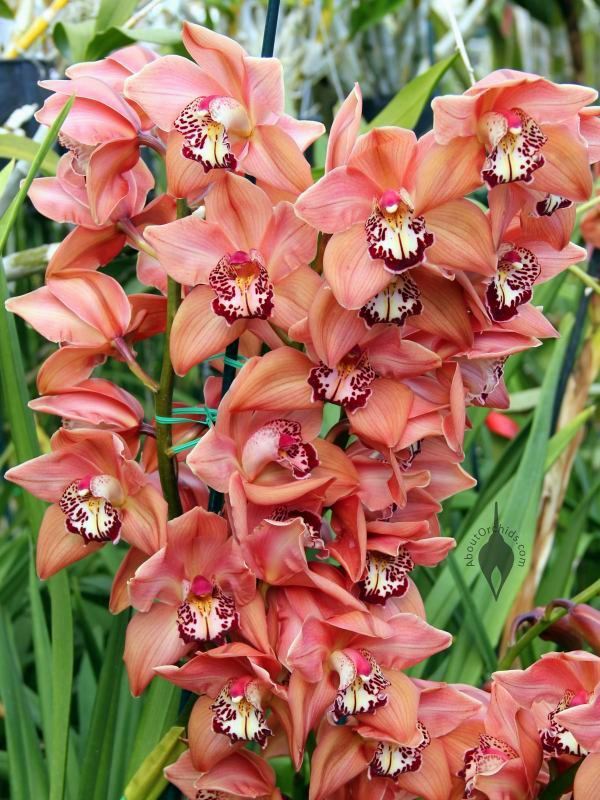
When I think of Santa Barbara, I think of Cymbidiums. Recently Dave traveled there for work, and he found plenty to photograph at the Santa Barbara Orchid Estate (SBOE). With 5 acres (2 hectares) of gardens in a mild coastal climate, it’s no surprise that Cymbidiums thrive there.

Santa Barbara Orchid Estate greenhouse benchesCymbidium flowersCymbidium flower

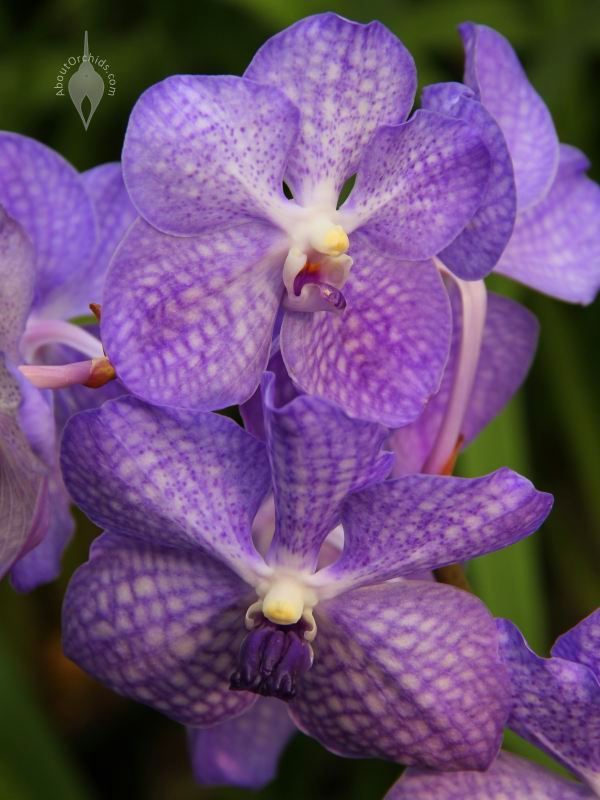
But Cymbidiums are only part of the story. Since 1957, SBOE has offered a wide range of orchids for sale, including many of their own hybrid creations. Their emphasis is on temperature-tolerant orchids which can grow outdoors in much of the country. Besides Cymbidiums, SBOE has many tropical varieties with electric colors, like the Dendrobium and Vandas below.

Australian Dendrobium hybrid at Santa Barbara Orchid EstateVanda flowersVanda hybrid

SBOE’s decades of orchid expertise shines through in these photos. Visitors are always welcome to enjoy the estate, browse their huge collections of hybrids and species, and ask orchid care questions. Their gardens also includes palms, aloes, succulents, and many rare plants. Can’t get to Santa Barbara? They’ll ship orchids around the country.

Cymbidium hybrid at Santa Barbara Orchid EstateMini Dendrobium flowersCymbidium flower and buds

Vanilla Crisis

Posted April 6th, 2012 by Marc Cohen
Categories: Fragrant Orchids, In the News, Warm Growers

How could the world’s most delicious orchid taste sour? Vanilla crop failures around the tropics are driving up prices for the beans. The world’s second most expensive spice (after saffron) is notoriously difficult to cultivate, and its cost is rising. Vanilla yields have fallen in India and Mexico by as much as 90% this year, leaving growers in Madagascar and Indonesia to fill the void. News of the poor crop has already lead to hoarding by speculators. Vanilla prices have jumped 20% in the past couple months, and ice cream prices may increase 10% as a result. Other vanilla products, from sweets to perfumes to medicines, will also feel the pinch. Synthetic vanilla, or vanillin, is a common substitute, and is unaffected by this shortage. Fortunately, this crisis doesn’t appear as severe as 2003’s, after a cyclone damaged the crop in Madagascar and prices soared into the stratosphere. But for those who want real vanilla beans, this current crisis will reach into your wallets.

Why You Need to Repot Your Orchid

Posted April 4th, 2012 by Marc Cohen
Categories: Botanical Gardens, Growing, Orchids in the Wild, Photos

It would be nice if you never had to repot your orchid, but you do. To understand why, consider how these orchids grow high in the trees at Hawaii Tropical Botanical Garden. This is how many orchids live in the wild. Their roots may grow in moss or rainforest debris, but mostly they’re exposed to the open air. In contrast, when old potting material breaks down in a container, air cannot circulate around orchid roots.

Cattleya orchid attached to tree at Hawaii Tropical Botanical GardenPhal orchid with flower buds attached to tree at Hawaii Tropical Botanical GardenMini Dinema orchid species growing on tree at Hawaii Tropical Botanical Garden

Without good air flow, roots cannot breathe, and the plant quickly dies. That’s why orchids need repotting, usually once every 2 – 3 years. Spring is the ideal time, since new roots will be happiest growing into new bark or moss. So don’t dread those repotting chores. Think of them as giving a breath of fresh air to your orchids. Check these helpful repotting tips, including how to know if your orchid needs repotting.

Cattleya orchid growing on tree at Hawaii Tropical Botanical GardenDendrobium orchid growing on tree at Hawaii Tropical Botanical GardenCattleya orchid growing on tree at Hawaii Tropical Botanical Garden

April Orchid Shows

Posted March 31st, 2012 by Marc Cohen
Categories: Botanical Gardens, Events

April brings orchid shows in every hemisphere. Sydney, Budapest, Chicago, and Houston are hosting big events. The Toronto Artistic Orchid Society emphasizes traditional Chinese orchids, but grows many modern varieties, too. All are welcome to their show.

April 1
North East of England Orchid Society Annual Show, Bowburn Community Centre, Bowburn, County Durham, UK
April 1
West Cornwall Orchid Society Spring Show, Blaythorne Holman Sports Club, Pendarves Rd, Camborne, Cornwall, UK
April 6 – 7
Charlottesville Orchid Society Show & Sale, Fashion Square Mall, Rt. 29 N., Charlottesville, Virginia
April 6 – 7
Bribie Island Orchid Society Show, Student Centre, Bribie Island State High School, First Ave., Bribie Island, Queensland, Australia
April 6 – 8
Gladstone Orchid & Foliage Society Show, Bill Robertson Toyota, Hanson Rd., Gladstone, South Australia, Australia
April 6 – 9
Orchilim 2012, Landcommandery Alden Biesen, Kasteelstraat 6, 3740 Rijkhoven, Belgium
April 7
Perlis Monthly Orchid Show, Taman Rimba Herba, Batu Pahat, Perlis, Malaysia
April 7
Solihull and District Orchid Society Spring Show, Arden School, Station Rd., Knowle, West Midlands, UK
April 7 – 8
Flamingo Gardens Orchid Society Show, Flamingo Gardens, 3750 S. Flamingo Rd., Davie, Florida
April 7 – 8
Utah Orchid Society Show, Red Butte Gardens, 303 Wakara Way, Salt Lake City, Utah
April 8
Penang Monthly Orchid Show, Penang Botanic Garden, Georgetown, Penang, Malaysia

Read the rest of this post »

Orchid Post Mortem: Orchis

Posted March 27th, 2012 by Marc Cohen
Categories: Cool Growers, Mini Orchids, Photos, Problems

When I first bought this unusual Japanese species at Pacific Orchid Expo 2009, I didn’t know if I could grow it. My purchase consisted of 3 tiny Orchis tubers, each smaller than a pea. Along with planting instructions for this mini terrestrial, the vendor included its Japanese name, uchouran, meaning “butterfly wing orchid.”

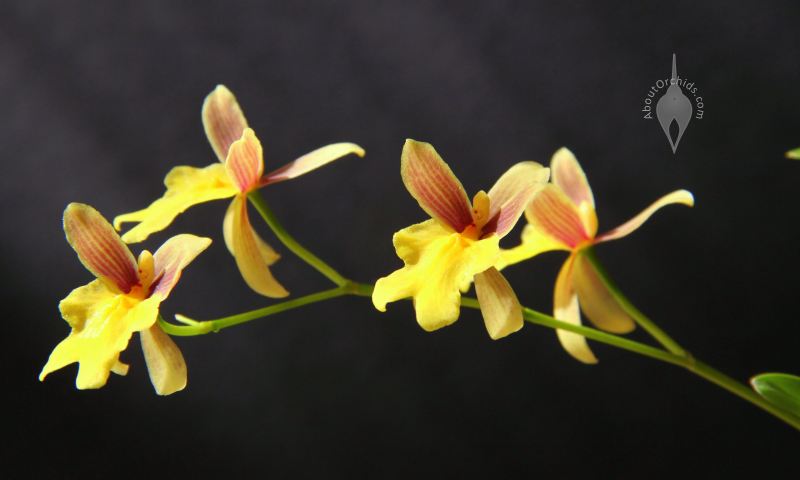
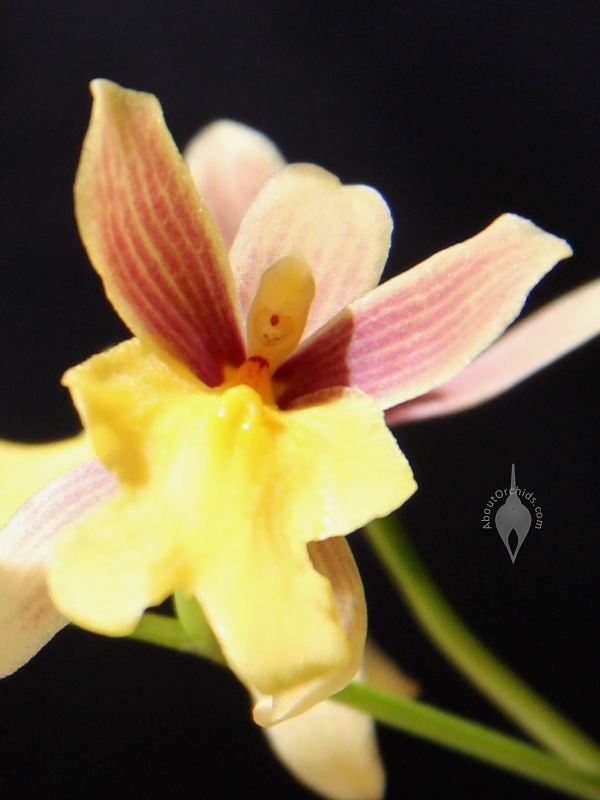
Orchis flowerOrchis flowers and budsOrchis flower

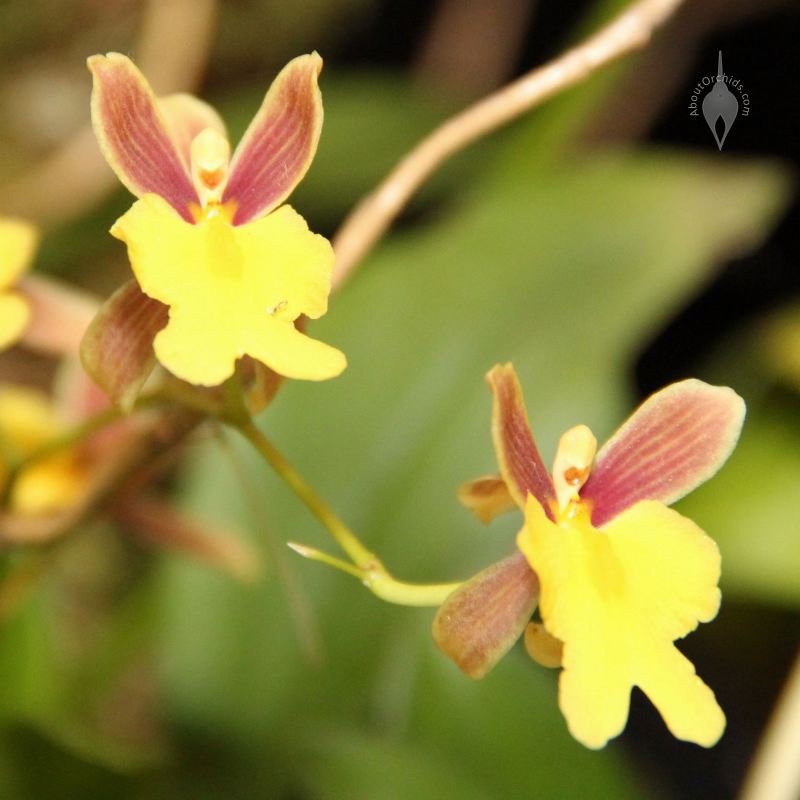
I planted the tubers, and 2 of them grew and bloomed well for a couple years. Then I lost one when it turned to mush in a heavy winter rain. The sole remaining plant grew, but had only a single feeble flower last summer, so I wasn’t surprised when it didn’t live through the winter. Happily, the flowers survive in photos.

Orchis flower, buds and leavesOrchis flowerOrchis flowers and bud

At this year’s Pacific Orchid Expo, I had an opportunity to talk to the vendor again, and explained how the Orchis had done well for a couple years, but then died off. He answered that they’re difficult to cultivate, often short-lived, and most of his were gone now, too. I felt a bit redeemed that I’d learned how to grow this uncommon species, if only briefly. Then I asked if he had any more for sale. They’d be worth another attempt, not just for the blooms, but to try to keep them alive longer. He didn’t have any, but I’m keeping my eyes open.

Spring Shade

Posted March 24th, 2012 by Marc Cohen
Categories: Growing

As we enjoy the sun’s ascent and longer daylight hours with spring, it’s time to move orchids from their brighter winter homes into shadier areas. Don’t wait until leaves turn yellow or sunburn. Since different orchid varieties need different light levels, consider what each requires for their spring and summer home. Many types, like Cattleyas, Cymbidiums, Dendrobiums, Epidendrums, Oncidiums, and Vandas, will enjoy morning sun. Phals, Paphs, and Masdevallias may tolerate some morning sun, but are best in shadier locales. Give orchids enough light to keep their leaves a light green color. Dark green leaves may mean there’s too little light for blooms.

This year, unusually warm temps in much of North America and Western Europe even have experienced growers keeping an eye on leaf color. Relying on spring moving dates from past years may not work, since the warmth can contribute to earlier sunburns. At the first sign of leaf yellowing, find some shade.

Springtime

Posted March 20th, 2012 by Marc Cohen
Categories: Botanical Gardens, Misc, Photos

To celebrate spring’s arrival, here are some flora and fauna pictures from our recent visit to Strybing Arboretum in Golden Gate Park. We didn’t see any orchids, but we did find a few of the garden’s other natural wonders.

Bloom in Golden Gate Park, San FranciscoHawk perched above the California Native Garden at Strybing ArborteumSucculent flower

For much of the country, winter has hardly made an appearance. San Francisco’s weather has been milder and drier than usual. Fortunately, much-needed winter rains have finally made an appearance this month. A hard-working honeybee can look forward to many more flowers, and the blooms and the warmth of the season are just beginning.

Honeybee in Golden Gate ParkMagnolia flowers at Strybing ArborteumIris bloom in Golden Gate Park