Mi Amor
Posted August 18th, 2008 by Marc CohenCategories: Messages
To my wonderful husband Dave,
With you in my life, the scent of orchids is even sweeter. I’d marry you over and over again (but I hope that won’t be necessary!)
All my love,
Marc
To my wonderful husband Dave,
With you in my life, the scent of orchids is even sweeter. I’d marry you over and over again (but I hope that won’t be necessary!)
All my love,
Marc
The Orchid Conservation Alliance (OCA) believes that the best hope to preserve orchid species is to preserve their native habitats. As tropical rainforests all over the world continue to be cut, burned, and paved, orchids are losing their homes. OCA funds orchid conservation by working to purchase and protect vital habitats, including hotspots of orchid diversity in the tropics. For the past few years, OCA has also organized trips to orchid habitats in Brazil.
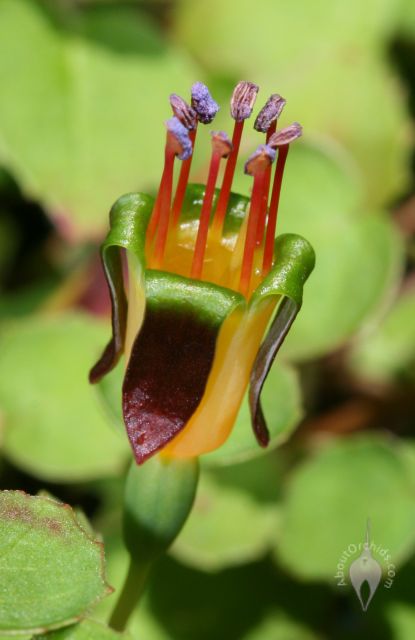
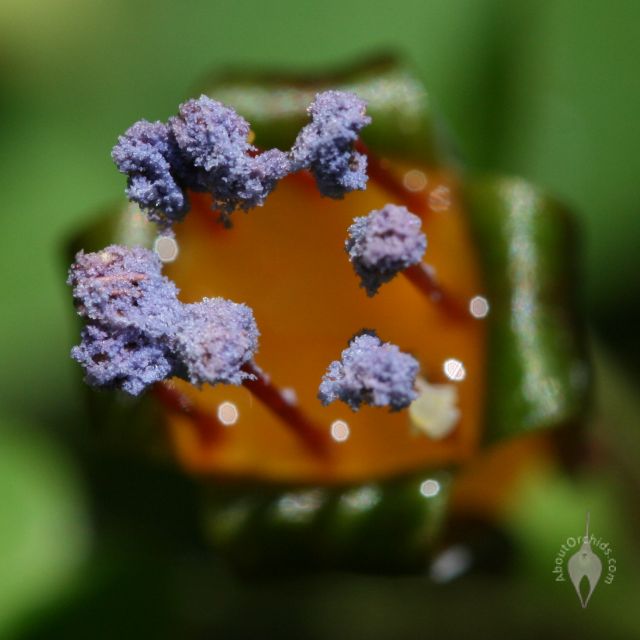
We’re preempting your regular orchid programming to bring you some non-orchid photos to enjoy. After a few notable heat waves in the spring, it’s been a cool and foggy summer here on the California coast. It’s perfect weather for this unusual Fuchsia procumbens, native to New Zealand. The small, colorful flowers trail down a raised flowerpot. Even the pollen is a colorful bluish purple.
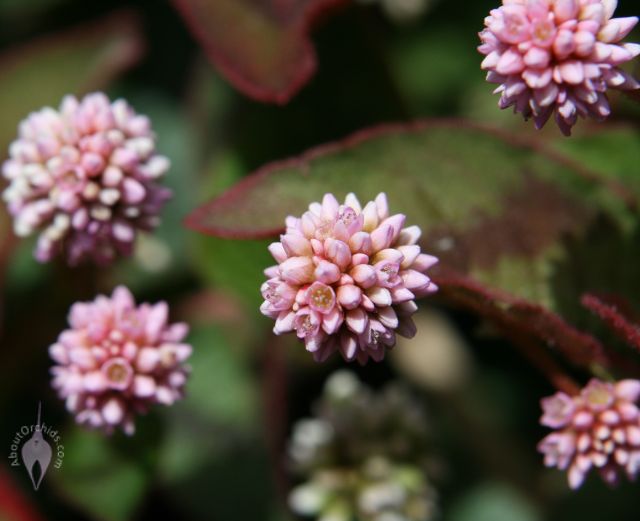
If you think these pink flowers are cute, imagine thousands of little pink puffs in bloom all year long. Pink clover (scientific name Persicaria capitata) arrived as weeds a few years ago in our back garden. They spread to make a great ground cover, growing out of every nook and cranny. The leaves are colorful too, with reddish variegation.
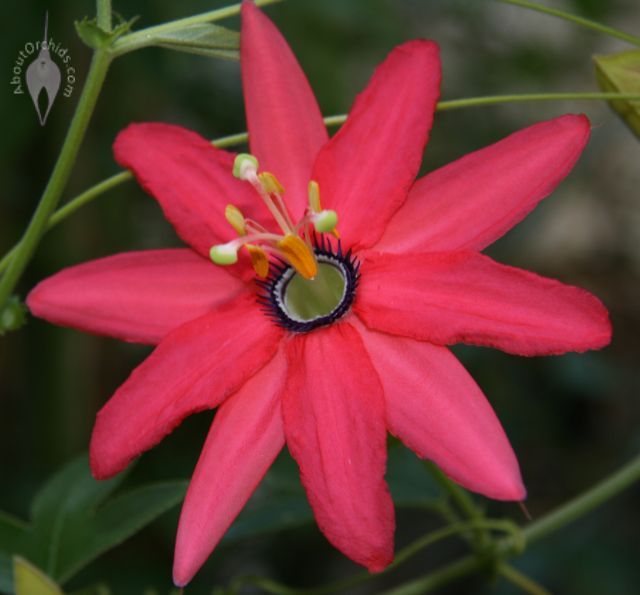
Passionflowers are vigorous growers, and this red Passionflower vine would take over the back yard without regular pruning. Each flower only lasts a few days, but with vines that stretch 4o feet (12 m) and more, there’s a regular supply of flowers.
Say “sah-LODGE-en-ee.” Kind of rhymes with “progeny.”
It may have a tough name, but these fragrant white and yellow flowers make up for it. This Coelogyne mooreana originates in the cloud forests of the mountains of Vietnam, and can handle a wide range of temperatures. Mine lives outside all year long here in San Francisco, and receives a few hours of direct sun each day.
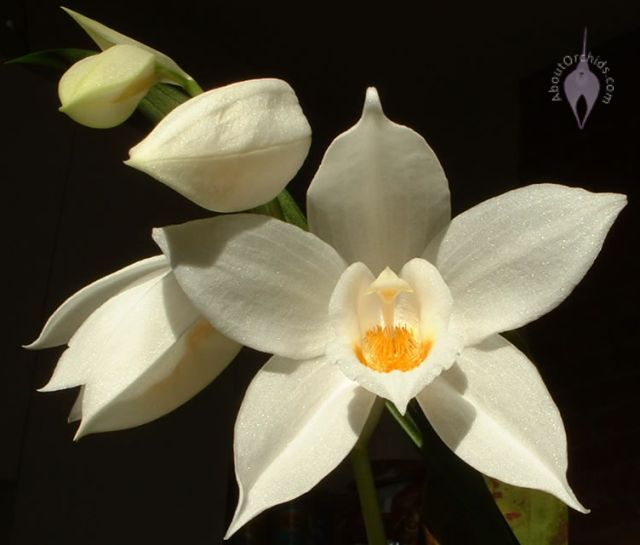
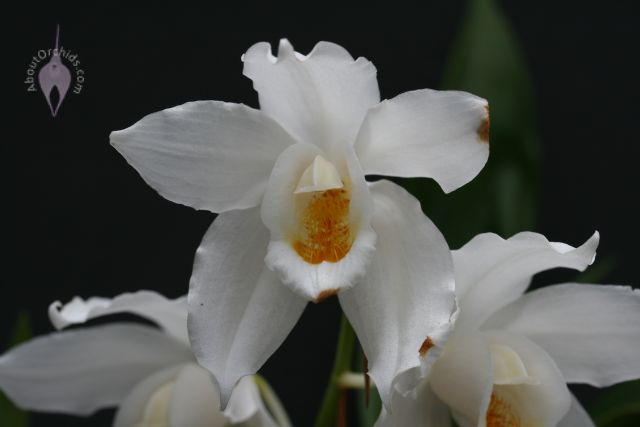
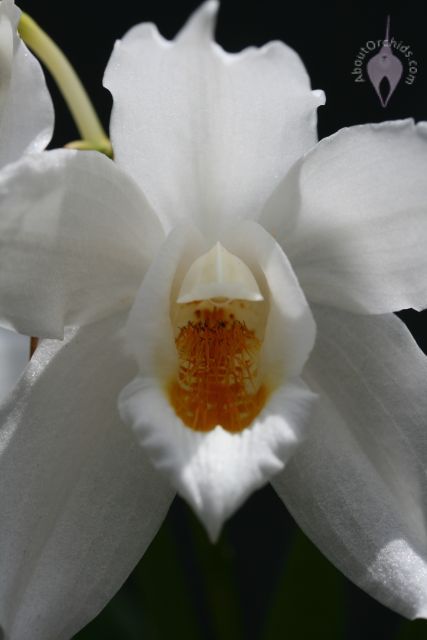
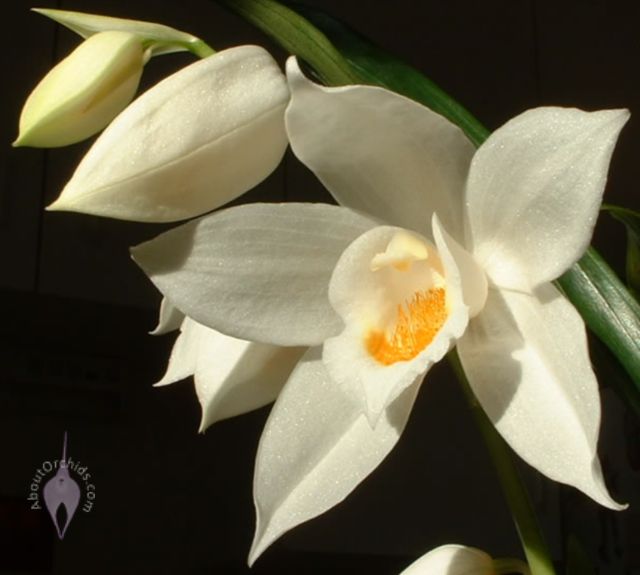
Coelogynes like a lot of water when they are growing in spring and summer, and then require a winter dormancy.
Besides lots of beautiful flowers to enjoy, orchid shows provide great opportunities to meet local growers and experts. There’s no better way to find good information about local growing conditions, and learn the best places to buy orchids and orchid supplies.
If an orchid refuses to bloom over the course of a year, one of the most common culprits is insufficient light. Here are a few tips to keep in mind:
• Light green or medium green leaves are a good indication that an orchid is receiving sufficient light. Dark green leaves may look attractive, but they usually mean that the plant is not getting enough light to bloom. New leaf growth that is soft, floppy, or more spindly than the old leaves can also indicate insufficient light.
• Distance from the light source greatly affects light strength. For an orchid, being placed more than a foot away (30 cm) from a window or light bulb can be equivalent to living in a dark cave. Many growers discover that repositioning a plant closer to a window brings it into bloom. Move it closer to the light source gradually, so as to prevent it from burning with a sudden increase in light or heat.
• Artificial light is fine for some orchids, such as Phalaenopsis and Paphiopedilum. Fluorescent lights work well since they last a long time, use little electricity, and don’t get very hot. Light bulbs should be close to the leaves, just 6-8 inches (15-20 cm) away, but not so close that leaves can burn.
• For orchids that want some direct sun, such as Vandas, Dendrobiums, and Cattleyas, morning sun is best. Direct sun at mid-day can burn leaves, and full sun in the afternoon can be too hot and drying.
• Unless you live in the tropics, winter brings shorter days and a weaker sun. To help compensate, orchids grown in natural light can be gradually moved into brighter light in the fall, and moved back into lower light in the spring.
Living in a city where space is at a premium, I can always appreciate the virtues of a small orchid. If it doesn’t need much room, it’s so much easier to rationalize why I should buy it. Many an orchid purchase has been preceded by the statement “I can squeeze it in somewhere since it’s small.”
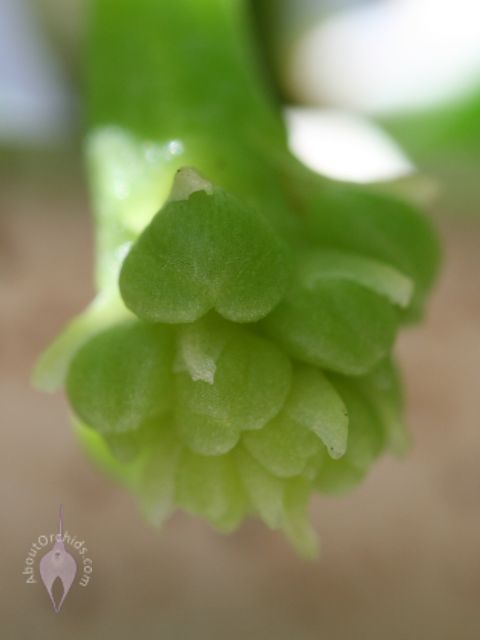
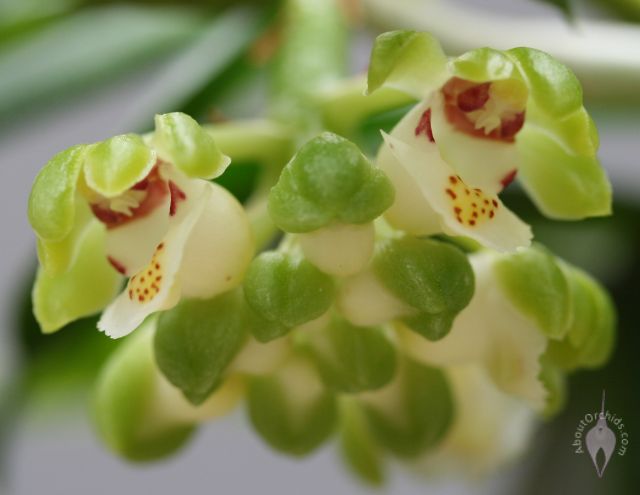
With that lack of willpower, you can imagine how I’ve accumulated mini orchids over the years. They may not have huge flowers like some Cattleyas, or grand arching sprays of flowers like Phalaenopsis, but mini orchids certainly have their charms. This Gastrochilus japonicus holds its tiny flowers below its leaves like a cluster of grapes. The whole flower cluster is only 1.5 inches (3.8 cm) across.
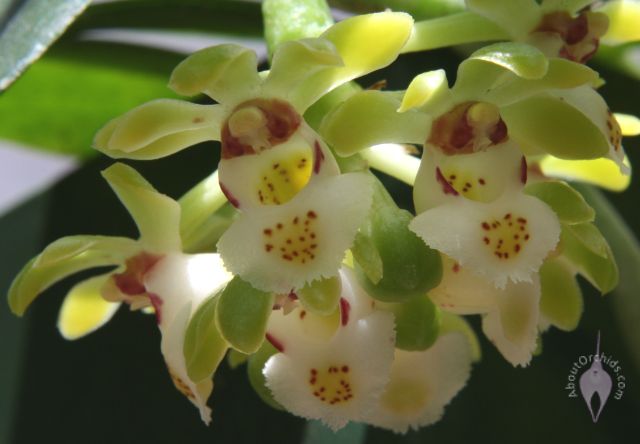

Despite its diminutive size, it’s quite hardy. It tolerates a wide range of temperatures in its native habitat, the shady pine forests of Japan and Taiwan. Pictures below show the flower spike when it was just starting to develop, and the flowers when they were starting to open.
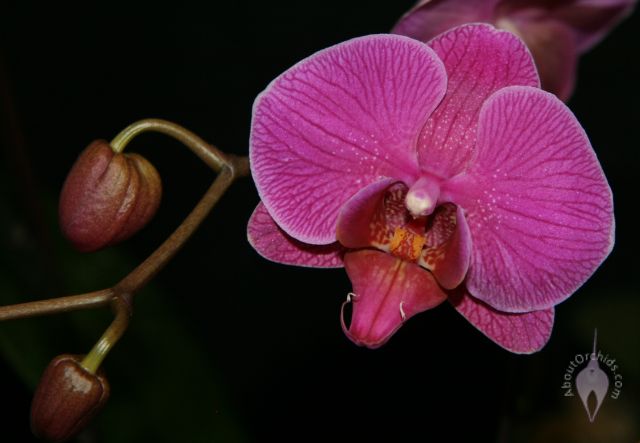
One of the most common questions I receive about orchids is how to force them to re-bloom ahead of their natural schedules. There is only one method I know to accomplish this, and it only works with Phalaenopsis. As soon as the last flower fades, cut the flower spike (the stem that holds the flowers) below the first flower. The best place to cut the spike is right above a node, which are the swollen “bumps” that segment the stem. Always use a sharp, clean scissors to prevent spreading plant diseases. You can clean the scissors with very hot water and soap, rubbing alcohol, or bleach solution. If the Phal is in good condition, it will grow a new flower spike below the cut and flower again.
Although this method can extend the blooming season for Phalaenopsis flowers, it does really sap energy from the plant. In the wild, these orchids would drop their flowers and start to store up energy to bloom again next year. By forcing the plant to re-bloom, the plant has no time to rest or build up its energy reserves. So if you plan to keep your orchid long-term and enjoy years of flowers, I would not advise forcing a re-bloom. If you want to push the orchid to its limit, you can force a re-bloom, but it may then require an extra long time to rest and recover when the 2nd set of flowers is finished.
The American Orchid Society, or AOS, promotes education, research, and conservation of orchids. Founded in 1921, the AOS publishes a monthly magazine, Orchids, filled with a wide range of orchid information and photos. From its headquarters, greenhouse, and botanical gardens in Delray Beach, Florida, the AOS educates about orchids and funds conservation efforts throughout the world. In addition to Orchids magazine, members receive access to great orchid care information, discussion forums, and discounted admission to many North American botanical gardens. For more information, visit the AOS at www.aos.org/
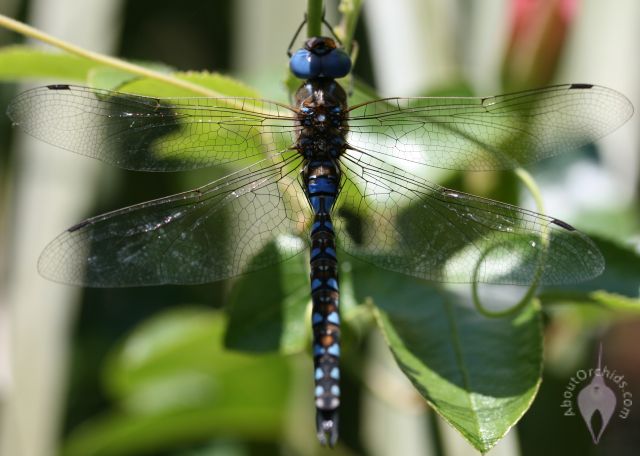
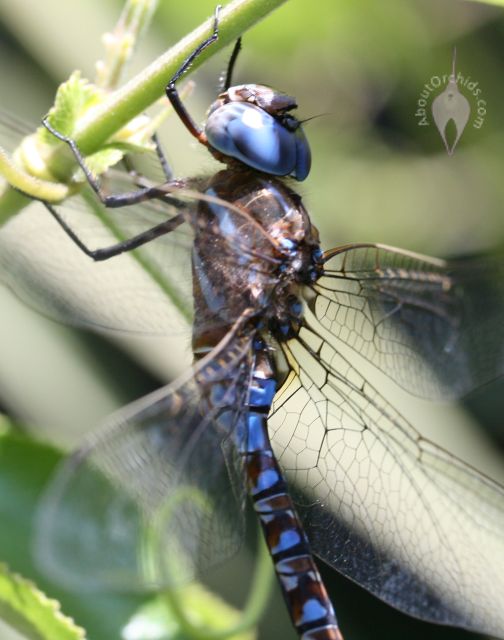
Well, not dragons really, but dragonflies. This one landed on a branch and stayed long enough to pose for Dave’s camera. With a little research, we identified it as a Blue-eyed Darner Dragonfly (scientific name Aeshna multicolor,) native to North America west of the Mississippi River. So what does this beautiful blue creature have to do with orchids? Dragonflies are beneficial insects, eating small pests, including mosquitoes. We really try to avoid pesticides in the garden, which kill beneficial insects just as efficiently as the nasty ones. So while we may have a few aphids, beneficials like this dragonfly do a far superior job keeping them under control than any toxic chemical. Plus we can enjoy Mother Nature right in the middle of a busy urban area.