Orchid Care During Heat Waves

Posted August 20th, 2012 by Marc Cohen
Categories: Fertilizing, Growing, Problems, Watering

With record-breaking heat waves and droughts the new normal, orchid growers need to adapt. High temperatures can damage or kill plants, and prevent most types from blooming. Adjust orchid care during excessive heat to keep them healthy and growing.

  • Most importantly in high temps, maintain good humidity and air movement. Warm growers, like Phals, Vandas, Cattleyas, and some Oncidiums, can manage increased heat as long as it is matched by increased humidity. For cool growing and intermediate growing orchids, constant high humidity is essential. Spray orchids with a mister, and group plants together. Keep pots atop pebbles in trays of water, always keeping the pots completely above the water level. Place plants near sources of water and water features.
  • Move plants into shade. If orchids are taking a summer vacation outdoors, bring them back inside to lower light and reasonable, climate-controlled temps. For orchids staying outdoors, move them under trees, which provide natural shade and add humidity from leaf transpiration.
  • In the heat, plants dry faster and need more frequent waterings, but be careful not to drown them. Maintaining high humidity works better than repeated waterings. As always, use enough water to run out the bottom, and let pots drain completely. Never allow orchid pots to sit in water for any extended period.
  • Even if the air conditioning is keeping up indoors, plants near windows feel more heat and dry faster. They should have extra water and humidity in a heat wave.
  • For many orchid varieties, excessive heat pushes plant metabolism to survival mode, and they cease using fertilizer. Stop fertilizing cool and intermediate growers in hot weather. Cut back fertilizer for warm growers, too.
  • Droughts and water restrictions spell trouble for moisture loving orchids. Even low-water Cattleyas don’t need frequent soakings, but still require moisture in the form of humidity. Water is a valuable resource, and water conservation should be an important consideration for all orchid growers.
Arctic Orchids

Posted August 15th, 2012 by Marc Cohen
Categories: Cool Growers, In the News, Orchids in the Wild, Photos

From Canada, the Ottawa Citizen tells of Arctic Orchids and Other Delights. If the phrase “Arctic orchids” sounds like a joke, keep in mind that orchids are the world’s largest flower family, and live on every continent but Antarctica. We know tropical orchids best, but Canada is home to dozens of species, like those celebrated at the annual Bruce Peninsula Orchid Festival. Further north, the Northern Bog Orchid doesn’t have the prettiest flowers, but it does have the ability to survive on the tundra of Baffin Island, which is better known for polar bears and glaciers. Scientists have just discovered it there on a recent expedition during this summer’s short growing season. It joins the Northern Coralroot Orchid which was already known from Baffin Island. “When people think of the Arctic they think of ice,” says Jeff Saarela, a botanist on the trek. “They don’t even think that there’s much life up there. But the Arctic is incredibly diverse. There are hundreds of species of plants and other organisms.”

Orchid aficionado

Mini Stenoglottis

Posted August 10th, 2012 by Marc Cohen
Categories: Dormancy, Growing, Intermediate Growers, Mini Orchids, Photos

As a city dweller with limited growing space, I can always appreciate a mini orchid. I was immediately intrigued by this charmer in a 2-inch (5-cm) flowerpot for sale at last winter’s Pacific Orchid Expo. My reward came a few months later with these tiny, light pink blooms. While this species’ flower spike can reach 7 inches (18 cm) or more, mine topped out around 5 inches (13 cm) tall.

Mini Stenoglottis species showing leaves and flowersStenoglottis flowersMini Stenoglottis flower close up

Rare in its native range, this terrestrial species is known from just a few places in South Africa and Zimbabwe. In cultivation, it doesn’t want much water. Most days I spray it with the mister, and only give it a thorough watering when the soil looks dry. Its thin leaves can burn in direct sun, so I keep it in bright light and good humidity with minimal morning sun.

Stenoglottis flowers and leavesStenoglottis flowersLarger flowers of a larger, related Stenoglottis species

A larger Stenoglottis relative shows off bigger flowers with more purple spots in the final photo. Both the larger species and the mini are deciduous. After dropping their leaves, they need to stay cool and dry over winter dormancy. Water once or twice per month to keep underground tubers from drying. New leaves emerge in spring.

Ghost Orchid Alert!

Posted August 7th, 2012 by Marc Cohen
Categories: Fragrant Orchids, In the News, Orchids in the Wild, Photos, Warm Growers

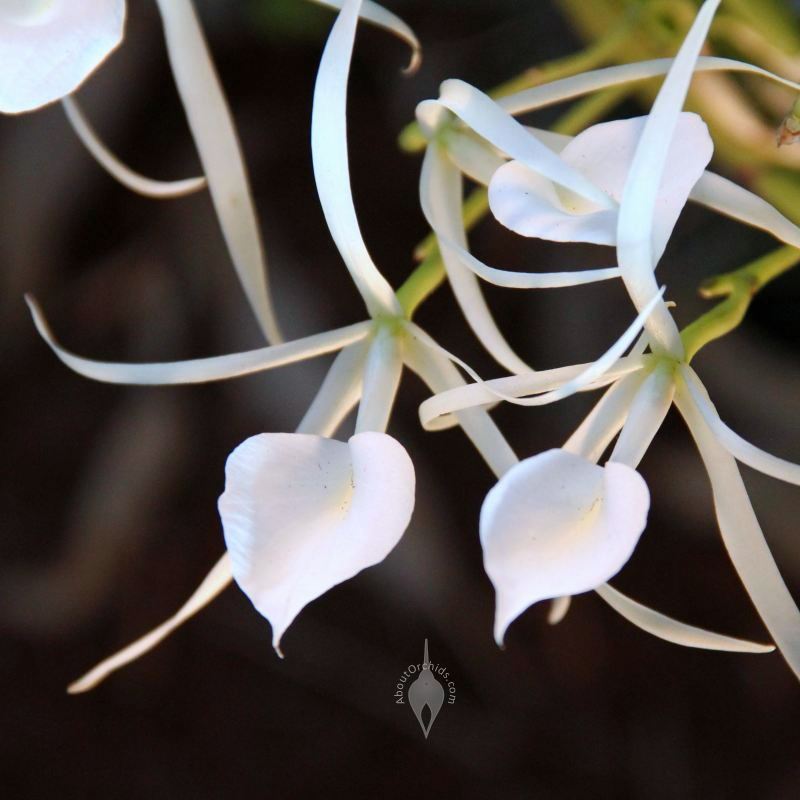
The Miami Herald has a Ghost Orchid alert! In Florida, the Audubon Corkscrew Swamp Sanctuary has a Ghost Orchid blooming within sight of its visitor boardwalk. Earlier in the summer, this plant’s first flower buds became grasshopper snacks, but 5 new buds have survived and opened. Besides the name Ghost Orchid, this species also goes by the name White Frog Orchid, since the curves of the flower lip resemble frog legs. Corkscrew Sanctuary preserves 13,000 acres (5261 hectares) of the Everglades, including North America’s largest remaining stand of old-growth Bald Cypress. Over the summer, the sanctuary is open to visitors from 7 a.m.- 7:30 p.m.

Ghost Orchid in bloom at an orchid show

Britain’s Bumper Crop of Orchids

Posted August 3rd, 2012 by Marc Cohen
Categories: Cool Growers, In the News, Orchids in the Wild

With the ongoing London Olympics and the Queen’s Diamond Jubilee, it would be easy to think that the UK is too busy to notice wildflowers right now. But the Brits have long been avid gardeners, and they certainly have noticed this year’s bumper crop of native orchids. A mild winter followed by a warm spring and copious rains have helped produce record numbers of Bee Orchids, Common Spotted Orchids, and Southern Marsh Orchids, among others. The Guardian even offers details on how to grow beautiful Bee Orchids in British lawns (hint: don’t use any fertilizers, herbicides, or moss killers.) The Irish Times describes a similar bumper orchid crop nearby in Ireland.
Most of these native terrestrial varieties, like Bee Orchids, have been more common in Mediterranean countries. Climate change has encouraged their northward spread, and now they are even appearing in southern Scotland where they were once rare. While the strange weather has benefited a few plants, many others, including farmers’ crops, have struggled. Despite this year’s orchid abundance, it’s worth remembering that these orchid species need very specialized growing conditions, and will die if they are dug up or transplanted. All are protected by conservation laws, so don’t harvest these crops.

August Orchid Shows

Posted August 1st, 2012 by Marc Cohen
Categories: Botanical Gardens, Events

Every month, as shows happen around the planet, the global appeal of orchids is obvious. Houston, Toronto, Rio de Janeiro, London, Brisbane, and Johannesburg are only a few of the locales with events in August.

August 2 – 7
Orquideas, Pajaros y Flores, Orquideorama del Jardin Botanico de Medellin, Medellin, Antioquia, Colombia
August 3 – 4
Houston Orchid Society Summer Workshop, St. Thomas Univ., Jerabeck Center, 3900 Graustark St., Houston, Texas
August 3 – 4
Second Annual Cattleya Symposium, Indian River Research and Education Center, 2199 South Rock Rd., Ft. Pierce, Florida
August 3 – 5
Hilo Orchid Society Show & Sale, Edith Kanakaole Stadium, Hilo, Hawaii
August 3 – 5
Orchids by the Sea Show, Dee Why RSL Club, Pittwater Rd., Dee Why, NSW, Australia
August 3 – 5
Exposicao de Orquideas, Anashopping, Anapolis, Goias, Brazil
August 3 – 5
Exposicao de Orquideas, Praca Sao Sebastiao, Tres Rios, Rio de Janeiro, Brazil
August 3 – 5
Exposicao Nacional de Orquideas, CTG, Sidrolandia, Mato Grosso do Sul, Brazil
August 3 – 5
D.O.G. Bewertungssitzung, Sommerfest bei der Gartnerei Gerhard Kronlein, Obereisenheim, Eisenheim, Germany
August 4
California Sierra Nevada Speaker’s Day, Odd Fellows Building, 1831 Howe Ave. at Alta Arden, Sacramento, California
August 4 – 5
Scone Palace Orchid Festival, Scone Palace, Perth, Scotland, UK
August 5
Southern Ontario Orchid Society Summerfest, Toronto Botanical Gardens, Lawrence Ave. E., Toronto, Ontario, Canada

Read the rest of this post »

The Orchid of Beer

Posted July 28th, 2012 by Marc Cohen
Categories: Misc, Photos

Summertime is a great time to relax with refreshing Storzette, “the Orchid of Beer.” Alas, only the ad campaign remains from this floral appeal to women in the 1950’s. “The original beer for women” was a creation of Storz Brewing in Omaha, Nebraska, and featured a colorful Cattleya on the label. “Created for the feminine taste”, in 8 ounce (237 ml) “queen size cans,” the brand and the ads hearken back to a time when orchids were a real extravagance. Cattleya or Cymbidium corsages adorned women on every formal occasion, from weddings to proms. First Lady Mamie Eisenhower frequently wore an orchid corsage (here’s a later picture of her wearing a Renanthera, a Vanda relative.) Storzette never had strong sales, and the brand didn’t last long, but Storz Brewing kept “the Orchid of Beer” slogan on other products for a few years.

Storzette Princess Pack with Cattleya flowersStorzette can top with Cattleya flowerStorz beer ad with Cattleya flower

Over the decades, breeding advances and mass marketing helped promote orchids from fancy corsages to common houseplants. I don’t know how much orchids inspired beer sales, but nowadays they appear standard in perfume ads. Storz Brewery closed in 1972.

Thanks to Brandon Vogel’s blog and Chronicles from the Analog Age blog for their histories and photos.

Office Orchids

Posted July 22nd, 2012 by Marc Cohen
Categories: Dormancy, Fertilizing, Growing, Photos, Problems, Watering

Orchids have been staples of office decor since supermarkets and garden centers began selling mass-produced plants in the 1980’s. Tough, modern hybrids can survive, and even thrive, in work environments which often have less than ideal growing conditions. Check the following tips to keep your office orchid blooming:

  • As always, it helps to know what kind of orchid you have. Phals (like the first picture below) are the most common type. Other varieties have different light, water, and temperature needs. If you can’t identify your orchid, use these basic care tips.
  • Maintaining good humidity is one of the biggest challenges for office orchids. Heaters and air conditioners can dry the air to desert-like levels. Keep orchids out of the direct path of heat or air vents. Group plants together. Place orchids on trays of pebbles and water, keeping the pots above the water level. Spray regularly with purified water or rainwater. Watch for pests which thrive in dry air, like spider mites, mealybug, and scale.
  • Low light can hinder office orchids from blooming. Natural light through a window, with supplemental light in winter, will make your plant feel like it’s living in the tropics. Close distance to the light source is important: light levels drop significantly just 1 foot (30 cm) from a window or bulb. Ceiling lights may be fine for human eyes, but are too far away to provide energy for photosynthesis. If you add artificial light, keep leaves 6 – 12 inches (15 – 30 cm) from bulbs, but not so close that leaves burn. Install a timer to turn on the light over weekends and holidays. Take advantage of white walls and other reflective surfaces to increase brightness.
  • Assuming you can’t control temperatures in your office, work with what you have. Remember that there are many great orchid choices, including lots of cool growers. Even the tiniest cubicle has a few different microclimates. Since heat rises, a high shelf can suit a warm grower, while a desk provides a home for an intermediate grower, and space on a floor harbors a cool grower.
  • Fertilizing weakly, weekly works best. Use ¼ – ½ the dose recommended on the label. Fertilize less often during winter dormancy.
  • Find reliable coworkers to babysit over vacations or sick days. Make sure they know to water enough to run out of the holes in the bottom of pot, and never to let the plant sit in water for any extended period. And don’t forget to tell them they can find answers to their orchid questions at AboutOrchids.com.

Moth Orchid hybridOncidium hybridDendrobium flowers

Paph flowerVuylstekeara hybridCattleya hybrid

An Orchid by Any Other Name Is a Marquee

Posted July 17th, 2012 by Marc Cohen
Categories: Fragrant Orchids, In the News, Photos, Warm Growers

Orchids have drawn the eye of The New York Times Fashion & Style section. The Times laments that becoming a “grocery staple” has dulled the mystique of once-exotic orchids. While Phals have become common, however, tens of thousands of other varieties continue to inspire. From elusive black orchid flowers to custom hybrids, orchids still spawn new markets. For example, anyone can attach their name to a new Cattleya cultivar for $1500, offering the chance for their very own floral marquee. When it comes to being trendy, orchids have just gotten started.

Fredclarkeara, the "black orchid"

Check the accompanying photo gallery in The Times to see Cattleya hybrids named in honor of Princess Diana, Queen Elizabeth II, Sarah Jessica Parker, Martha Stewart, several first ladies, and other celebrities.

The Scent of Scandal: Greed, Betrayal, and the World’s Most Beautiful Orchid

Posted July 14th, 2012 by Marc Cohen
Categories: Books

PK lady slipper
Can the prestige and profit of an orchid discovery make people, even reputable institutions, flout the law? You bet they can. And when it’s the dazzling PK lady slipper, the most important orchid discovery in a century, you can bet it involves lying, cheating, search warrants, subpoenas, and criminal fines. Author Craig Pittman recounts the intricate story in The Scent of Scandal: Greed, Betrayal, and the World’s Most Beautiful Orchid. With complications like inadequate conservation laws and rampant rainforest destruction, its twists and turns are drawing comparisons to the classic Maltese Falcon. In this bloodless drama, Marie Selby Botanical Gardens in Sarasota, Florida has the dubious distinction as the only US botanical garden ever to be found guilty of smuggling. Rushing to be the first to name the new species, Selby experts knowingly used a plant brought illegally from Peru. This well researched book dives into the depths of orchid obsession.

“FANTASTIC. If I did not know most of the main players I would have thought the author had a vivid and twisted imagination.”—Paul Martin Brown, author of Wild Orchids of Florida

“A fascinating true story of obsession, greed, and lust for the unobtainable. Reminds me a great deal of The Maltese Falcon. This rare flower is definitely the stuff that dreams are made of.”—Ace Atkins, author of Devil’s Garden and Infamous