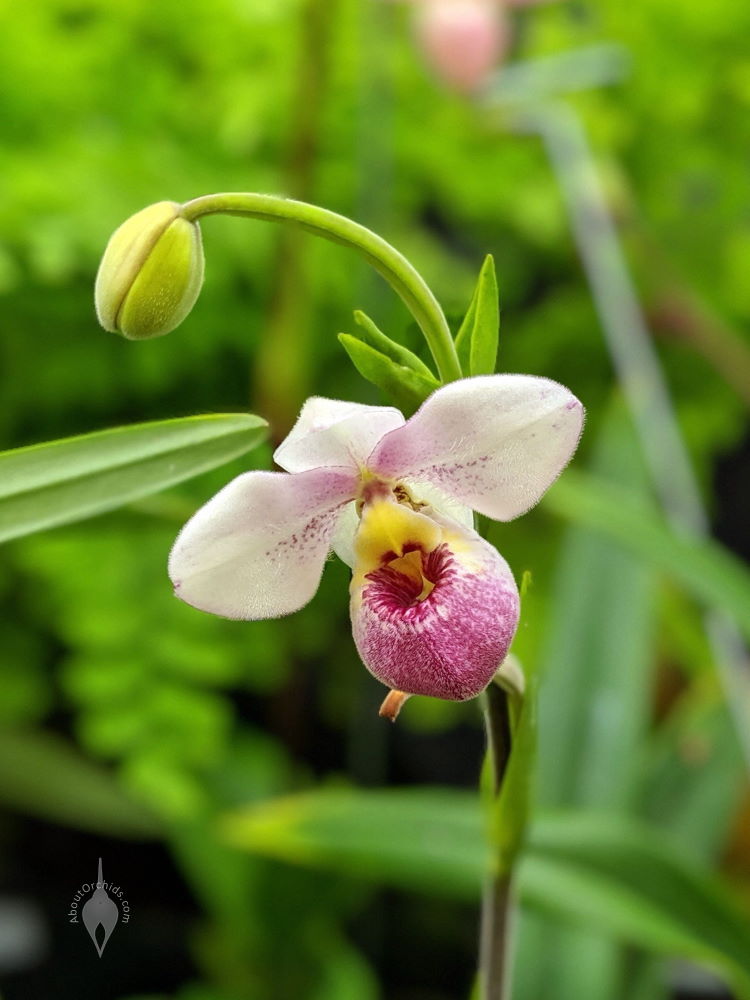
A Lady Slipper Standing Tall

Posted August 8th, 2021 by Marc Cohen
Categories: Intermediate Growers, Photos

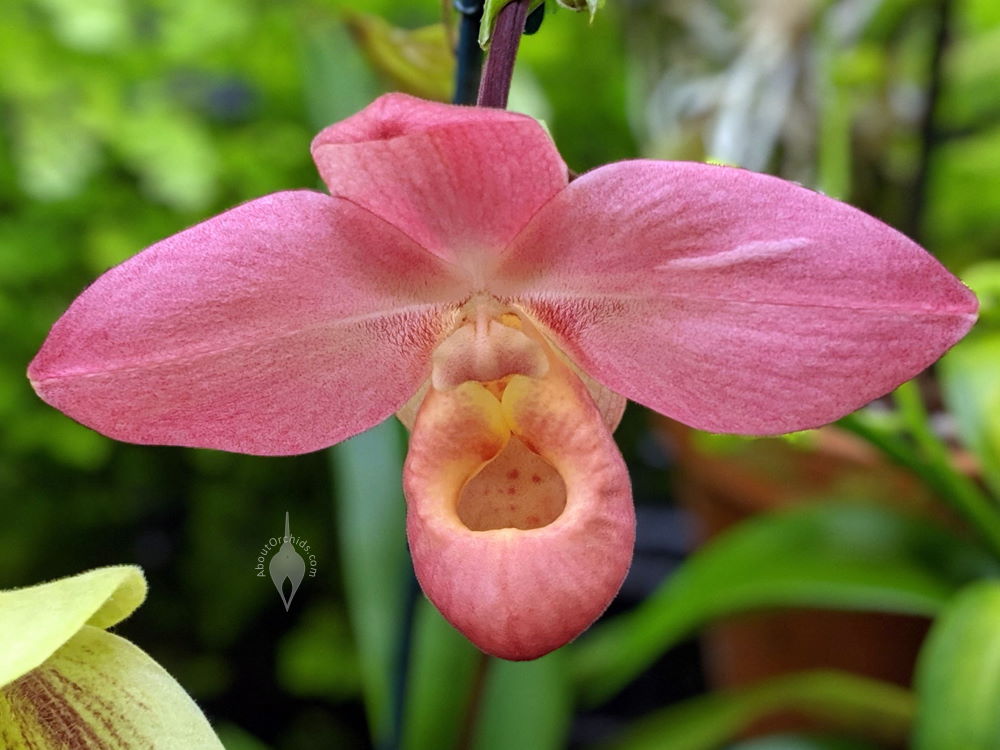
Paphiopedilum, orchid hybrid flower, Paph, Lady Slipper, grown indoors in Pacifica, CaliforniaPaphiopedilum, orchid hybrid flower, Paph, Lady Slipper, grown indoors in Pacifica, CaliforniaPaphiopedilum, orchid hybrid flower close up, Paph, Lady Slipper, grown indoors in Pacifica, California

Alien-looking Lady Slippers beg the question of how strange flowers from another planet might be. While this Paph comes from right here on Earth, it looks like something from a sci-fi movie. It’s an unidentified hybrid that I bought a few years ago in a grocery store. These photos show various angles of this wondrous flower.

Paphiopedilum, orchid hybrid flower bud, Paph, Lady Slipper, grown indoors in Pacifica, CaliforniaPaphiopedilum, orchid hybrid flower, close up of flower lip, Paph, Lady Slipper, grown indoors in Pacifica, CaliforniaPaphiopedilum, orchid hybrid flower, side view of flower lip, Paph, Lady Slipper, grown indoors in Pacifica, California

That amazing 6 inch (15 cm) wide bloom stands on a stem over 1 foot (30 cm) tall. So far, I’ve only coaxed a single flower out of the plant at one time, but it usually lasts more than two months in good condition. This Paph also has marvelous mottled leaves, visible in the third row of photos. Its light green and dark green variegation makes it a very attractive plant, even without its alien blossom. I can only guess what its ancestry could be, but I suspect that one parent is Paphiopedilum sukhakulii. And maybe the other parent is from a different galaxy.

Paphiopedilum, orchid hybrid flower and leaves, variegated leaves, Paph, Lady Slipper, grown indoors in Pacifica, CaliforniaPaphiopedilum, side view of orchid hybrid flower, Paph, Lady Slipper, grown indoors in Pacifica, CaliforniaPaphiopedilum, orchid hybrid leaves, variegated leaves, Paph, Lady Slipper, grown indoors in Pacifica, California

August Orchid Events

Posted August 1st, 2021 by Marc Cohen
Categories: Events

Even as more people are vaccinated, we are still in a pandemic. If an indoor event doesn’t mention basic health precautions, I’m not going to list it here. That means I’ve left shows off this month’s list, as I have in past months. When safety measures are publicized, people will feel safer, and will return to shows, auctions, and conferences.

August 6
International Phalaenopsis Alliance Symposium, Highland Manor, 503 E Main St., Apopka, Florida
August 8
Peninsula Orchid Society Summer Show & Sale, San Mateo Garden Center, 605 Parkside Way, San Mateo, California
August 14
Diablo View Orchid Society Late Summer Auction, Contra Costa Water District Parking Lot, 1331 Concord Ave., Concord, California
August 21
PhalFanatics Phalaenopsis Symposium, online speakers, auction, and culture workshop; USD $45 registration fee for nonmembers, $35 for members
August 27 – 28
Waitakere Orchid Club Spring Show, Kelston Community Centre, Great North Rd. & Awaroa Rd., Glendene, Auckland, New Zealand
August 27 – 29
Melbourne Orchid Spectacular, Boxhall Pavilion, KCC Park, 655 Westernport Hwy., Skye, Victoria, Australia

Good Practices and Bad Habits of Nature Photography

Posted July 26th, 2021 by Marc Cohen
Categories: Books, Conservation, In the News

There have always been irresponsible or criminal people who destroy the nature that they claim to love. Social media seems to have worsened that trend. Some are so focused on getting a popular photo that they trample over rare plants. Others rip out surrounding greenery to take a clearer shot. I’ve watched in horror as people ignored fences and warning signs, and then crushed endangered native species in pursuit of a selfie.

The Botanical Society of Britain & Ireland spoke with Jon Dunn, author of Orchid Summer, and ecologist Callum Macgregor about responsible photography practices. Their tips include:

  • Don’t harm nearby plants to improve your view. Consider different angles to get a clear shot, and incorporate plants as background. Gently push aside grasses, or temporarily weigh them down with light objects, like knitting needles.
  • Learn how to get the most from your camera. Practice with it. Change settings or use software filters to focus on your subject, and blur the background. Photo editing software can remove intrusive vegetation.
  • To prevent trampling, stay on paths whenever possible. Don’t lie down to take pictures, or you’ll flatten a large area. Never go over fences or barriers. Pay attention to signs and warnings. Set up a tripod and remote control, or a telephoto zoom, to take shots from a distance.
  • Remove GPS data before posting pictures. Sadly, ignorant and immoral people utilize posts to pinpoint rare plants and steal them. You can change settings on your camera or phone to prevent photos from showing this info. Some social media sites may automatically delete EXIF data, which contains locations. Check out these tips to learn more about removing metadata.
  • If you find something rare or protected, notify local conservation authorities. They may be able to provide extra protection for the plants.
  • Connect with other nature lovers, and spread these helpful tips.

My Little Red Sarcochilus

Posted July 20th, 2021 by Marc Cohen
Categories: Cool Growers, Mini Orchids, Photos

Sarcochilus Kulnura Spice x Fairy, orchid hybrid flower, red flower with red and white lip, miniature orchid, grown outdoors in Pacifica, CaliforniaSarcochilus Kulnura Spice x Fairy, orchid hybrid flowers buds and leaves, red flowers with red and white lip, miniature orchid, grown outdoors in Pacifica, CaliforniaSarcochilus Kulnura Spice x Fairy, orchid hybrid flowers and leaves with water drops, red flowers with red and white lip, miniature orchid, grown outdoors in Pacifica, California

Sarcochilus Kulnura Spice x Fairy, orchid hybrid flower, flower close up, partially open flower, red flower with red and white lip, miniature orchid, grown outdoors in Pacifica, CaliforniaSarcochilus Kulnura Spice x Fairy, orchid hybrid flowers buds, red flowers with red and white lip, miniature orchid, grown outdoors in Pacifica, CaliforniaSarcochilus Kulnura Spice x Fairy, orchid hybrid flowers buds and leaves with water drops, red flowers with red and white lip, miniature orchid, grown outdoors in Pacifica, California

About five years ago, I bought this little Sarcochilus hybrid at an orchid show, and it’s been a reliable bloomer. It pumps out brilliant red flowers from a four inch (10 cm) pot for a month or two in late spring and early summer. They’re such a rich red that my cell phone camera can’t do them justice, but I think the color in the photos is impressive nonetheless.

Sarcochilus Kulnura Spice x Fairy, orchid hybrid flowers and leaves with water drops, red flowers with red and white lip, miniature orchid, grown outdoors in Pacifica, CaliforniaSarcochilus Kulnura Spice x Fairy, orchid hybrid flowers and leaves with water drops, red flowers with red and white lip, miniature orchid, grown outdoors in Pacifica, CaliforniaSarcochilus Kulnura Spice x Fairy, orchid hybrid flowers, flower close up, partially open flowers, red flowers with red and white lip, miniature orchid, grown outdoors in Pacifica, California

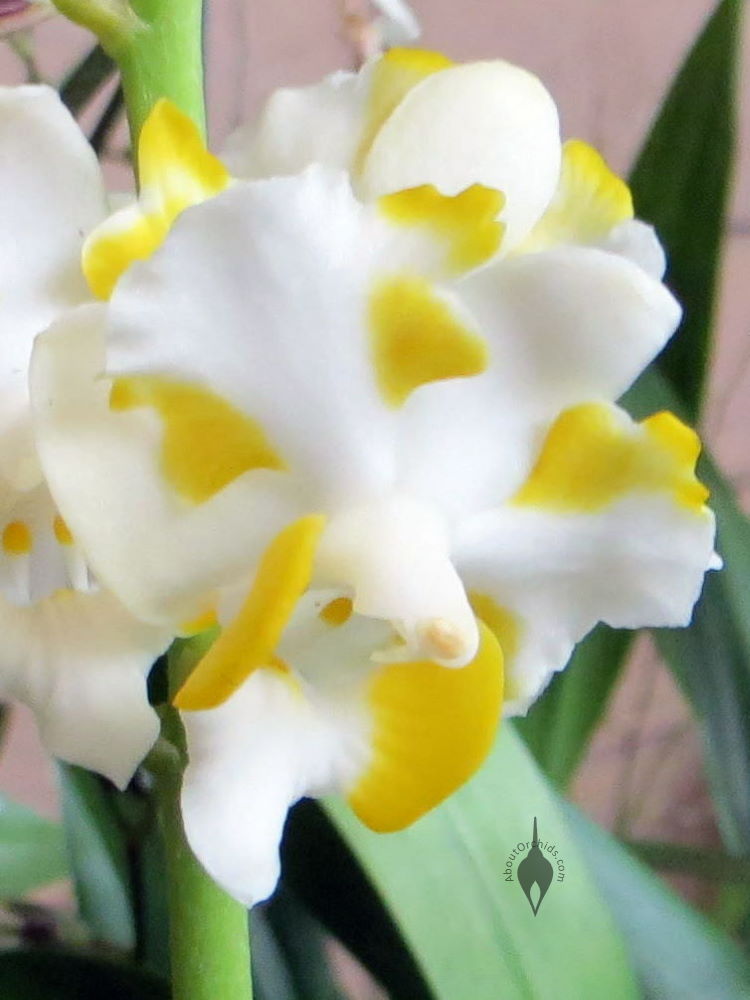
When I bought this hybrid, it didn’t have a registered name. Instead, the nametag listed two parents, Sarcochilus Kulnura Spice and Sarcochilus Fairy. Its flower buds and stems start growing with red spots on a white background, but as the buds mature, they turn redder until the white disappears. This plant lives outdoors all year. It’s near a close relative, Sarcochilus hartmanii, an Australian species which also thrives on the Northern California coast. That species blooms regularly with crystal white flowers (shown in the final photo below.) It’s a larger plant than the hybrid, and I believe it tolerates our chilly winds better. Still, the small hybrid grows little by little each year. With luck, these dazzling red blossoms will continue to grace our garden for a long time.

Sarcochilus Kulnura Spice x Fairy, orchid hybrid flowers and buds, red and white flowers, miniature orchid, grown outdoors in Pacifica, CaliforniaSarcochilus Kulnura Spice x Fairy, orchid hybrid flowers and buds with water drops, red and white flowers, miniature orchid, grown outdoors in Pacifica, CaliforniaSarcochilus Kulnura Spice x Fairy, orchid hybrid flower buds with water drops, red and white flower buds and stems, miniature orchid, grown outdoors in Pacifica, California

Sarcochilus Kulnura Spice x Fairy, orchid hybrid flower, red flower with red and white lip, miniature orchid, grown outdoors in Pacifica, CaliforniaSarcochilus Kulnura Spice x Fairy, orchid hybrid flowers buds and leaves, red flowers with red and white lip, miniature orchid, grown outdoors in clay pot in Pacifica, CaliforniaSarcochilus hartmanii, orchid species flowers, white and red flowers, Australian native orchid, miniature orchid, grown outdoors in Pacifica, California


Cooking up Winning Recipes with Florida-Grown Vanilla

Posted July 13th, 2021 by Marc Cohen
Categories: In the News, Warm Growers

Vanilla is a very delicious orchid, and it’s one of the most expensive flavorings in the world. The majority of vanilla beans are grown in Madagascar, and the USA imports a lot of them. Scientists are working to establish a vanilla industry in South Florida’s hot, humid climate. A plant geneticist at the University of Florida has tested hundreds of cultivars. He’s also teamed up with a Miami chocolatier to cook with vanilla from the university’s greenhouses, and it was a great success. The variety they used has many desirable traits, including high vanillin levels. They’re hoping to prove that it can become a sustainable Florida crop. If they’re successful, home-grown vanilla may find a place in America’s kitchens.

The Surprising Putty Root Orchid

Posted July 6th, 2021 by Marc Cohen
Categories: Cool Growers, Orchids in the Wild, Photos
Thanks so much to my friend Carola, who has generously let me post her photos of Putty Root Orchids near her home in Virginia. She’s taken pictures over the seasons, so they illustrate a year in the life of this extraordinary North American species. These orchids boast handsome leaves with alternating green and silvery-white pinstripes. Surprisingly, the new leaves emerge in autumn, remain over winter, and then die back in spring as the plants start to bloom. The first row of photos shows the leaves in late winter, and a young flower spike popping up in May.

Aplectrum hyemale, Putty Root Orchid, Adam and Eve Plant, North American native orchid species, variegated leaves, pin-striped leaves with alternating silvery-white and green stripes, growing wild in Virginia among brown fallen leaves in late winterAplectrum hyemale, Putty Root Orchid, Adam and Eve Plant, North American native orchid species, variegated leaf, pin-striped leaf with alternating silvery-white and green stripes, growing wild in Virginia among brown fallen leaves and fallen branch in late winterAplectrum hyemale, Putty Root Orchid, Adam and Eve Plant, North American native orchid species, flower spike emerging in May, growing wild in Virginia among brown fallen leaves and fallen branch

Aplectrum hyemale has earned the nickname Putty Root Orchid because of the traditional use of its sticky mashed tubers as glue. It’s also called the Adam and Eve Plant because its tubers grow as linked pairs. The species is native to eastern Canada and much of the eastern half of the USA. After blooming in the spring or early summer, their flowers often self-pollinate. Shedding their leaves before summer lets the plants avoid heat stress. By growing fresh leaves in fall, they take advantage of extra winter sunlight coming through the bare tree branches above.

Aplectrum hyemale, Putty Root Orchid, Adam and Eve Plant, North American native orchid species, variegated leaves with flowers, growing wild in Virginia among brown fallen leaves in springAplectrum hyemale flowers, Putty Root Orchid, Adam and Eve Plant, North American native orchid species, growing wild in Virginia in springAplectrum hyemale, Putty Root Orchid, Adam and Eve Plant, North American native orchid species, variegated leaves, pin-striped leaves with alternating silvery-white and green stripes, growing wild in Virginia among brown fallen leaves and branches in October

The last two rows of pictures show the progression from spring blooms to swelling seedpods in autumn, and then winter’s cold. The final two photos below, with plants coated in ice on a chilly December day, are not what most people expect when they think of orchids.
Aplectrum hyemale seedpods, Putty Root Orchid, Adam and Eve Plant, North American native orchid species, growing wild in Virginia in autumnAplectrum hyemale, Putty Root Orchid, Adam and Eve Plant, North American native orchid species, variegated leaves covered in ice, pin-striped leaves with alternating silvery-white and green stripes, growing wild in Virginia among brown fallen leaves in DecemberAplectrum hyemale, Putty Root Orchid, Adam and Eve Plant, North American native orchid species, variegated leaves and seedpods covered in ice, pin-striped leaves with alternating silvery-white and green stripes, growing wild in Virginia among brown fallen leaves in December

Whenever discussing native plants, it’s important to remember never to take orchids from the wild. It’s illegal, and the plants don’t survive in cultivation. Take only photos, and leave only footprints. Be careful not to step on nearby vegetation if you’re admiring these surprising orchids. Photos courtesy of Carola Haas.

July Orchid Events

Posted July 1st, 2021 by Marc Cohen
Categories: Events

Most in-person orchid events are still on hold. Even as the pandemic recedes in well-vaccinated parts of the world, it can take months to organize exhibits or auctions. With hope, they can safely return soon.

July 10
North Shore Orchid Society Winter Show, Albany Village Hall, Albany Hwy. & Library Ln., Albany, Auckland, New Zealand
July 10
Hawkes Bay Orchid Society Winter Show, Clive Hall, 162 Main Rd., Clive, New Zealand
July 10
A subtribo Laeliinae no Rio Grande do Sul, Brasil, presented by Associação Portuguesa de Orquidofilia; online conference in Portuguese with Luiz Filipe Varella
July 12
American Orchid Society Judges Forum, online event; open to AOS judges, prospective judges, and those interested in joining the judging program; registration required
July 17 – 18
Waikato Orchid Society Winter Show, Hamilton Gardens, Cobham Dr., Hamilton, New Zealand
July 31
Orchid Digest Speakers Day: A Virtual Experience, expert speakers and Q&A after each presentation; $30 (USD) registration fee

Colombia’s Orchids for Peace

Posted June 26th, 2021 by Marc Cohen
Categories: Conservation, In the News

Colombia is a land of orchids, home to over 4000 native species. Cattleya trianae is the beloved national flower. Sadly, the country has suffered decades of violence and political instability. A fragile peace accord has started to heal the nation. Now, Colombians like María Luisa Hincapié and her family are hoping that orchids can help to keep the peace. They’ve been growing a “Forest of Orchids,” restoring part of a denuded tropical jungle.

When María Luisa’s family bought the land in 2001, it had been scraped clean of any vegetation. The was soil dry and impoverished due to overgrazing. Since then, her family has done the work of restoring the native vegetation of the mountainside by planting a native orchid reserve—part of their shared vision to change the story of Colombia from one of violence and destruction to one of restoration and healing. With orchids.

As they’ve replanted the forest, the area has regenerated. Insects and animals have returned. The family has propagated native orchid varieties, and returned them to the wild. Many of these orchids are endangered, facing the perils of habitat destruction, illegal trafficking, shrinking numbers of pollinators, and climate change. The Hincapiés have already saved some orchids from extinction, and discovered new species. For this family of orchid addicts, it’s a labor of love to save these magnificent flowers, and to save their country, too. As I’ve blogged about before, there are others in Colombia working towards the same goals. The hashtag #orquideasparalapaz (orchids for peace) is being used to help promote their cause.

The Splendid Beauty of San Francisco’s Japanese Tea Garden

Posted June 20th, 2021 by Marc Cohen
Categories: Misc, Photos

South Gate, large traditional Japanese garden gateway, Japanese Tea Garden, Golden Gate Park, San Francisco, CaliforniaPlants reflected in pond with water lilies, topiary, cloud pruning, Japanese Tea Garden, Golden Gate Park, San Francisco, CaliforniaCamellia flower, red white and pink flower, Japanese Tea Garden, Golden Gate Park, San Francisco, California

Celebrate today’s summer solstice with photos from San Francisco’s exquisite Japanese Tea Garden. It’s the oldest public Japanese garden in the country, and one of many wonders of Golden Gate Park. Dave and I went there recently after we were fully vaccinated. We hadn’t been in years, and we really enjoyed visiting again. It features lots of greenery, lanterns, pagodas, winding paths, ponds, a Zen garden, and a tea house. There are numerous Japanese native plants, but I didn’t spot any orchids.

Drum Bridge with children, semicircular wooden bridge, Japanese Tea Garden, Golden Gate Park, San Francisco, CaliforniaLarge koi goldfish in pond with child's hand pointing at it, Japanese Tea Garden, Golden Gate Park, San Francisco, CaliforniaTall stone lantern in foreground with colorful plants, pond, large stones, and waterfall in background, Japanese Tea Garden, Golden Gate Park, San Francisco, California

Coast Redwood, Sequoia sempervirens, close up of new green leaves, conifer, Japanese Tea Garden, Golden Gate Park, San Francisco, CaliforniaBronze Buddha statue, cast in 1790 in Tajima Japan, Japanese Tea Garden, Golden Gate Park, San Francisco, CaliforniaBamboo, Japanese Tea Garden, Golden Gate Park, San Francisco, California

Wandering through the garden, there’s so much to discover. The elegant design provides alluring sights around every curve. Exquisitely maintained plants are each a work of art, with beauty in both their large forms and their small details. Somehow the old, large koi don’t get eaten by the park’s many raccoons or herons. The Drum Bridge, with its semi-circular arch, is fun to climb for kids and adults alike. Immersed in the garden’s charms, visitors may forget that the busy city is nearby.

Hydrangea flowers and leaves, Japanese Tea Garden, Golden Gate Park, San Francisco, CaliforniaDrum Bridge viewed behind tree, semicircular wooden bridge, Japanese Tea Garden, Golden Gate Park, San Francisco, CaliforniaTop of Temple Gate, Japanese Tea Garden, Golden Gate Park, San Francisco, California

Stone path between trees bushes and grasses in dappled shade, Japanese Tea Garden, Golden Gate Park, San Francisco, CaliforniaIris flower, partially open flower, purple yellow and white flower, Japanese Tea Garden, Golden Gate Park, San Francisco, CaliforniaOriginal fortune cookie presses on display inside the gift shop, circa 1914, Makoto Hagiwara inventor of modern version of fortune cookie, Japanese Tea Garden, Golden Gate Park, San Francisco, California

There’s plenty of fascinating history to the Japanese Tea Garden. It began in 1894 as an exhibit in an international fair. Afterwards, it was made permanent and expanded to about 5 acres (2 hectares.) Landscape architect Makoto Hagiwara and his family were its caretakers for decades, and they lived on the grounds. Sadly, they lost their home and were interned with other Japanese Americans during World War II. Fortunately, their beloved garden continues to thrive, and is one of the park’s most popular attractions. Besides the garden, Mr. Hagiwara is famous as one of the inventors of the modern fortune cookie. The first fortune cookie presses are on display inside the gift shop (shown in the final photo.)

Rare Orchids Found on London Rooftop Garden

Posted June 17th, 2021 by Marc Cohen
Categories: In the News

Eleven stories above London, the Small Flowered Tongue Orchid, Serapias parviflora, has found a home on the roof of a bank. Fifteen of the plants have bloomed on the green rooftop, which boasts 159 plant species living alongside solar panels. This is the first time that the Small Flowered Tongue Orchid has been seen in the UK since 1989. It’s more common to the south around the Mediterranean. Orchid seeds are tiny, and travel far with the wind, so they may have blown in from overseas. London’s green roofs are offering new habitats for continental arrivals.